Visualizzazione post con etichetta roman. Mostra tutti i post

sabato 5 aprile 2025

Maitreyi di Mircea Eliade - recensione letteraria / Maitreyi by Mircea Eliade - book review


Carissimi amici e lettori,

Oggi recensirò il romanzo Maitreyi dello scrittore rumeno Mircea Eliade. Fare riferimento a Mircea Eliade solo come scrittore significherebbe sminuire la sua opera e la sua persona perché Mircea Eliade era filosofo, saggista, storico delle religioni, antropologo, orientalista, mitografo, esoterista e accademico, avendo lui insegnato all’università di Sorbona, Ecole des Hautes Etudes e finalmente all’università di Chicago, negli Stati Uniti. Mircea Eliade è sempre stato un grande viaggiatore e uomo di cultura, parlava 8 lingue e aveva collaborato con le più grandi personalità del tempo come Carl Gustav Jung, Eugène Ionesco, Giuseppe Tucci, Ernst Junger e tanti altri. Il suo viaggio in India dal 1928 al 1931 segnò il suo orientamento filosofico e letterario. Varie sue opere furono il risultato di questa esperienza, tra le quali anche il romanzo che recensirò oggi, Maitreyi.

Alla prima vista, Maitreyi sembra essere un romanzo d’amore ma in realtà è molto più. Il filo conduttore di questo romanzo è infatti la storia di amore che nasce fra Maitreyi, un’adolescente appartenente ad una ricca famiglia indiana ed Allan, un giovane impiegato di origini europee, trovatosi in India per motivi lavorativi ai tempi in cui il paese era ancora una colonia britannica. A questo filo conduttore s’intrecciano anche componenti mistici, filosofici, etici nonché aspetti importanti del romanzo di formazione per convogliare armoniosamente in una splendida unione che ha come risultato un romanzo complesso e allo stesso tempo semplice. Oltre ai nostri personaggi principali, ad animare le poco più di due cento pagine di questo libro abbiamo anche: l’ingegnere Narendra Sen, padre di Maitreyi e datore di lavoro di Allan, sua moglie, la signora Sen, Chabu, sorella più giovane di Maitreyi, Harold, amico e confidente di Allan, Geurtrie, amica spasimante di Allan e un lungo numero di dipendenti della famiglia Sen, con ruoli per niente trascurabili nello sviluppo della narrazione.

La narrazione è fluida e coinvolgente come una danza che passa con eleganza da movimenti soavi a pause di angoscia e apprensione e culmina con ritmi allerti di sofferenza e vero strazio. Il linguaggio è ricco, ricercato e allo stesso tempo comprensibile ad un livello istintivo. Leggere questo romanzo è come sperimentare un abbraccio, quando senti ogni particolare dell’altro, senza andare a guardare o cercare, lasciandoti semplicemente coinvolgere da un punto di vista sensoriale, affettivo, psicologico e affettivo in un’esperienza edificante.

Non voglio raccontare aspetti di questo romanzo perché vorrei incoraggiarvi a scoprirlo personalmente e vi assicuro che sarà un’esperienza indimenticabile. Io l’ho letto due volte nella mia vita, la prima volta in adolescenza, in rumeno, la lingua in cui fu scritto in origine e adesso in italiano, quanto una mentalità diversa e con molta più esperienza come lettore ed entrambe le volte sono rimasta affascinata. Forse la seconda volta l’ho apprezzato ancora di più, vuoi per la mia passione per le lingue straniere, che avvolgono tutto in suono più melodico e dolce alle mie orecchie, vuoi perché con il tempo ho approfondito meglio certi concetti, ma la conclusione rimane la stessa, Maitreyi è un romanzo che raccomando caldamente.


ENGLISH

Dear fiends and readers,

Today I will review the novel Maitreyi by the Romanian writer Mircea Eliade. Referring to Mircea Eliade only as a writer would belittle his work and his person because Mircea Eliade was a philosopher, essayist, historian of religions, anthropologist, orientalist, mythographer, esotericist and academic, having taught at the Sorbonne University, Ecole des Hautes Etudes and finally at the University of Chicago, in the United States. Mircea Eliade has always been a great traveler and a man of culture, he spoke 8 languages ​​and had collaborated with the greatest personalities of the time such as Carl Gustav Jung, Eugène Ionesco, Giuseppe Tucci, Ernst Junger and many others. His trip to India from 1928 to 1931 marked his philosophical and literary orientation. Several of his works were the result of this experience, including the novel I will review today, Maitreyi.

At first glance, Maitreyi seems to be a romance novel but in reality, it is much more. The underlying theme of this novel is in fact the love story that develops between Maitreyi, a teenager from a rich Indian family and Allan, a young employee of European origins who found himself in India for work at a time when the country was still a British colony. Mystical, philosophical, ethical components as well as important aspects of the Bildungsroman are also intertwined with this underlying theme to harmoniously convey a splendid union that results in a complex and at the same time simple novel. In addition to our main characters, the little more than two hundred pages of this book are also animated by: the engineer Narendra Sen, Maitreyi's father and Allan's employer, his wife, Mrs. Sen, Chabu, Maitreyi's younger sister, Harold, Allan's friend and confidant, Geurtrie, Allan's amorous friend and a long list of employees of the Sen family, with roles that are by no means negligible in the development of the narrative.

The narration is fluid and engaging like a dance that elegantly passes from gentle movements to pauses of anguish and apprehension and culminates with alert rhythms of suffering and true torment. The language is rich, refined and at the same time understandable on an instinctive level. Reading this novel is like experiencing a hug, when you feel every detail of the other, without going to look or search, simply letting yourself be involved from a sensorial, emotional, psychological and affective point of view in an edifying experience.

I don’t want to reveal to you the aspects of this novel because I would like to encourage you to discover it personally and I assure you that it will be an unforgettable experience. I have read it twice in my life, the first time in adolescence, in Romanian, the language in which it was originally written and now in Italian, with a different mentality and with much more experience as a reader and both times I was fascinated. Perhaps the second time I appreciated it even more, either because of my passion for foreign languages, which envelop everything in a more melodic and sweet sound to my ears, or because over time I have better explored certain concepts, but the conclusion remains the same, Maitreyi is a novel that I warmly recommend.


ROMANA

Dragi prieteni si cititori,

Astăzi voi face o recenzie a romanului Maitreyi al scriitorului român Mircea Eliade. Referindu-ne la Mircea Eliade doar ca scriitor, ar bagateliza opera și persoana lui, deoarece Mircea Eliade a fost filozof, eseist, istoric al religiilor, antropolog, orientalist, mitograf, ezoterist și academic, care a predat la Sorbona University, Ecole des Hautes Etudes și în cele din urmă la Universitatea din Chicago, în Statele Unite. Mircea Eliade a fost întotdeauna un mare călător și un om de cultură, a vorbit 8 limbi și a colaborat cu cele mai mari personalități ale vremii precum Carl Gustav Jung, Eugène Ionesco, Giuseppe Tucci, Ernst Junger și mulți alții. Călătoria sa în India din 1928 până în 1931 a marcat orientarea sa filozofică și literară. Câteva dintre lucrările sale au fost rezultatul acestei experiențe, inclusiv romanul pe care îl voi revizui astăzi, Maitreyi.

La prima vedere, Maitreyi pare a fi un roman de dragoste, dar în realitate este mult mai mult de atat. Tema de bază a acestui roman este, de fapt, povestea de dragoste care se dezvoltă între Maitreyi, o adolescenta dintr-o familie indiană bogată, și Allan, un tânăr angajat de origini europene care s-a găsit în India pentru muncă într-o perioadă în care țara era încă o colonie britanică. Acest fir comun include și componente mistice, filozofice, etice precum și aspecte importante ale Bildungsromanului, care converg armonios într-o unire splendidă care are ca rezultat un roman complex și în același timp simplu. Pe lângă personajele noastre principale, cele mai puțin de două sute de pagini ale acestei cărți sunt animate și de: inginerul Narendra Sen, tatăl lui Maitreyi și angajatorul lui Allan, soția sa, doamna Sen, Chabu, sora mai mică a lui Maitreyi, Harold, prietenul și confidentul lui Allan, Geurtrie, prietena si admiratoarea lui Allan, dar si o listă îndelungată de angajati ai familiei Sen, cu un roluri neglijabile în dezvoltarea narațiunii.

Narațiunea este fluidă și captivantă asemeni un dans care trece elegant de la mișcări blânde la pauze de angoasă și aprehensiune și culminează cu ritmuri alerte de suferință și chin adevărat. Limbajul este bogat, sofisticat și în același timp ușor de înțeles la nivel instinctiv. Citirea acestui roman este ca experienta unei îmbrățișari, când simți fiecare detaliu al celuilalt, fără a fi nevoie să te uiți sau să cauți, pur și simplu lăsându-te implicat din punct de vedere senzorial, emoțional, psihologic și afectiv într-o experiență edificatoare.

Nu vreau să vă povestesc aspecte ale acestui roman pentru că aș dori să vă încurajez să îl descoperiți personal și vă asigur că va fi o experiență de neuitat. L-am citit de două ori în viața mea, prima dată în adolescență, în limba română, limba în care a fost scris inițial, iar acum în italiană, cu o altă mentalitate și mult mai multă experiență de cititor, și de ambele ori m-a fascinat. Poate a doua oară l-am apreciat și mai mult, fie din cauza pasiunii mele pentru limbile străine, care învăluie totul într-un sunet mai melodic și mai dulce pentru urechi, fie pentru că de-a lungul timpului am înțeles mai bine anumite concepte, dar concluzia rămâne aceeași, Maitreyi este un roman pe care îl recomand cu căldura.


Disclaimer e premesse / Disclaimer and premises

IT: Questo post non ha scopi commerciali e non incoraggia vendite, denominazioni, immagini ed eventuali link presenti sono solo a scopo informativo. Le immagini ritraggono un prodotto acquistato regolarmente che ho valutato in quanto consumatore. Questo post è di mia completa creazione per quanto riguarda contenuti, foto e idee espresse. Prima di usare qualsiasi parte di questo post siete pregati di contattarmi e nel caso vi abbia ispirato per altre creazioni, vi chiedo cortesemente di menzionare la fonte.

ENG: This post has no commercial purposes and does not encourage sales, names, pictures and eventual links are present only for an informative purpose. The images depict a regularly purchased product that I have evaluated as a consumer. This post is of my entire creation as for contents, photos and expressed ideas. Before using any part of it, you need to contact me and in case it inspired you for other creations, I gently ask you to mention the source.


martedì 28 gennaio 2025

Luntrea lui Caron de Lucian Blaga - recenzie de carte / Il traghetto di Caronte di Lucian Blaga - recensione letteraria / Charon's Ferry by Lucian Blaga - book review


Dragi cititori,

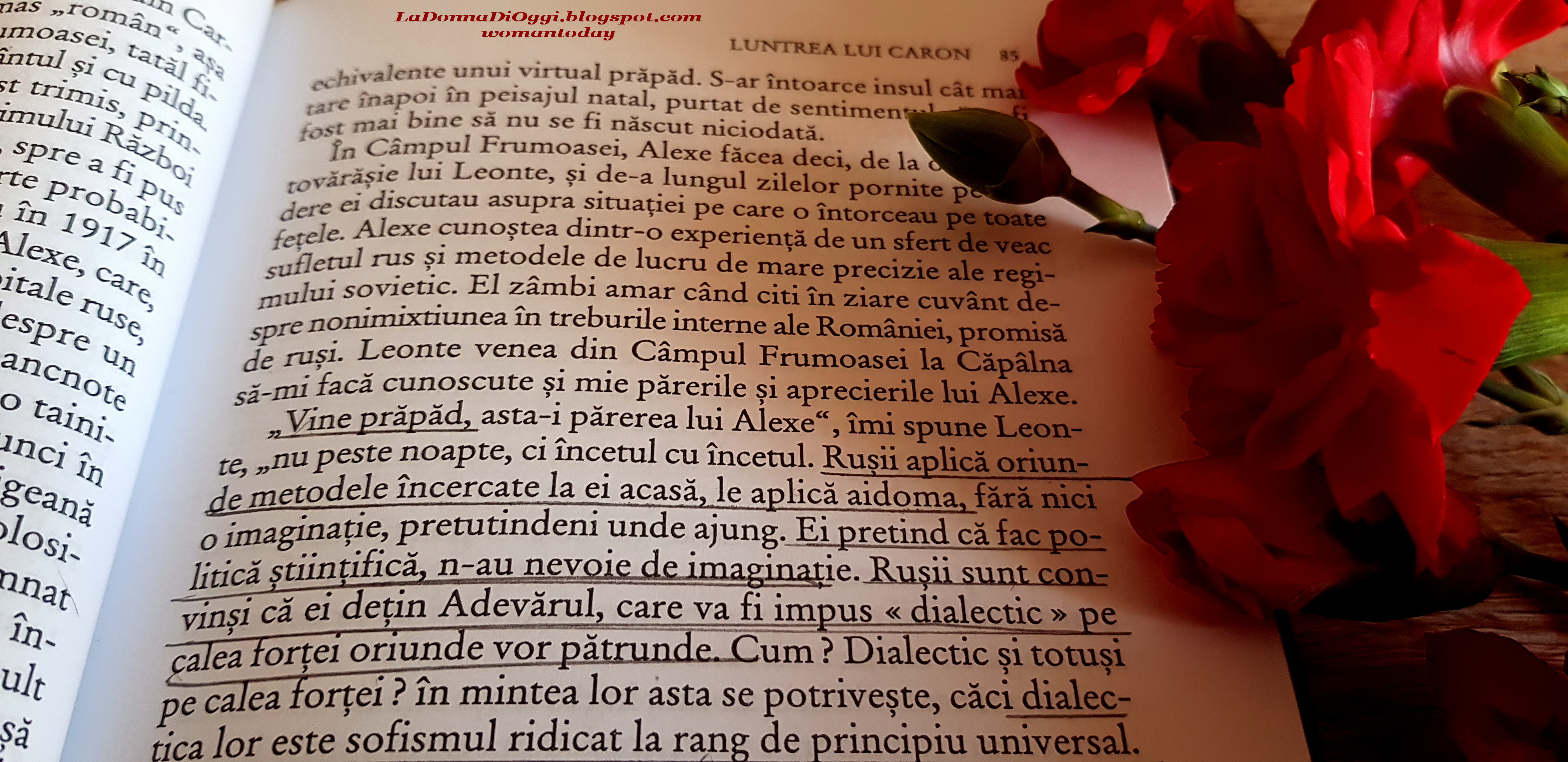
Articolul de astazi trateaza unul din cele mai importante opere ale literaturii romanesti si anume romanul Luntrea lui Caron al poetului si filosofului Lucian Blaga. Cum probabil stiti, acest roman a facut parte timp de decenii din “literatura de sertar” a poporului nostru datorita limitarilor si interdictiilor arbitrare si nesabuite ale regimului comunist, fiind publicat postum, la 30 de ani de la moartea scriitorului.

In ciuda aspectului autobiografic, naratiunea este facuta la prima persoana, autorul se divide in doua personaje, poetul Axente Creanga si filosoful Leonte Patrascu pentru a surprinde in totalitate complexitatea vietii sale, Luntrea lui Caron este in esenta si un roman istoric intrucat zugraveste cu precizie uluitoare tumultul schimbarilor relative sfarsitului celui de-al doilea razboi mondial si instaurarii regimului comunist in Romania. Lucian Blaga surprinde metodic in toate componentele sale sosirea rusilor, promisii salvatori ai natiunii care prin manevre destabilizante creaza haos, teroare, nevoi pentru a propune in final un sistem materialistic, redundant si repetitiv in care constiinta este anulata si singurul organ de referinta ramanand stomacul. Multumita unor personaje diametral opuse, precum Alexe Pacurariu, intelectual burghez si erou in conflictele cu rusii, si Simion Barda, tanar scriitor de orientare marxista, fenomenul instaurarii este suprins in toata complexitatea retelelor create. In ciuda entuziasmului cu care Simion Barda asteapta aceste schimbari, nici “ochelarii de capastru” cu care regimul doteaza fiecare nou element al organismului, nu pot ascunde realitatea faptelor, o cursa a dezadaptatiilor social, a frustratilor si infometatiilor care va sfarsi contaminand intreaga natiune. In final, recunostiinta unui comunist se va manifesta doar prin punerea pe “linie moarta” spre diferenta de toti ceilalti cetateni “dotati” cu ceva agoniseli, experiente, functii care au sfarsit in inchisori sau "voluntari" la munca fortata. 

Intr-o perioada in care informatiile erau limitate, situatia era atat de disfunctionala incat stiri despre soarta svabilor din Romania, a fostilor functionari sau a cetatenilor care nu se adecvau tiparului, ieseau la iveala cu furia oarba pe care doar frica o poate alimenta. In aceste contexte Lucian Blaga introduce personaje pitoresti care dau culoare romanului si i-l anima, personaje precum Octavia si sotul ei, Popa Vasile, brodnicii ce asista  lumea in perindarea peste Mures, senzuala Ana Rares si adolescentinul ei sot, doamna Marga si satenii de la Capalna care croiesc universul acestui roman, contribuind la nararea aspectului politic si istoric sau fiind elemente cheie in povestile de dragoste si in poetica acestei lucrari. Dezvoltarea unui univers romantic in paralel cu evenimentele istorice si cu adevarate tratate de filozofie, stau ca marturie de neragaduit a talentului acestui scriitor roman. 

Lucian Blaga fusese numit pentru premiul Nobel de catre intelectualii epocii dar nebeneficiind de sustinerea guvernului sau intrucat personaj reactionar, i s-a negat aceasta recunoastere. Figura sa publica si creatiile precedente l-au salvat, asemeni altor oameni de seama, de la inchisori, tortura si moarte intrucat regimul nu dorea sa creeze martiri ci doar automate care raspund la comenzi.

Capacitatea lui Lucian Blaga de a crea figuri de stil este uimitoare, la fiecare pagina poeziile sale se contureaza in strofe sau pur si simplu astern drumul unor creatii, unor metafore revelatoare. In acest sens doresc sa mentionez metafora pastorului de lupi care isi ascunde si isi trece ciurda peste Mures nestingherit.

Luntrea lui Caron nu este doar o marturie, nu este doar un roman istoric ci este si un tratat de filozofie. In paginile sale gasim analize elaborate pe problematici politice, precum tratatul de la Ialta prin care occidentul a devenit unealta de expansiune a comunismului, religie, bogomilism, erezii, metamorfoza pacatului stramosesc patriotism, originea limbii romane si culminand cu analiza metamorfozei om – divinitate. Luntrea lui Caron este in acelasi timp punct de plecare pentru analize si reflectii elaborate precum si tratat bine structurat si elaborat de filosofie. Luntrea lui Caron e aproape un compendiu de cunoastere si din acest motiv lectura sa este un act indatorat.


ITALIANO

Carissimi lettori,

L'articolo di oggi riguarda una delle opere più importanti della letteratura rumena, ovvero il romanzo Il traghetto di Caronte, del poeta e filosofo Lucian Blaga. Come forse saprete, questo romanzo ha fatto parte per decenni della "letteratura da cassetto" del nostro popolo a causa delle limitazioni e dei divieti arbitrari e sconsiderati del regime comunista e viene quindi pubblicato postumo, 30 anni dopo la morte dello scrittore. 

Nonostante l'aspetto autobiografico, la narrazione è fatta in prima persona, l'autore è diviso in due personaggi, il poeta Axente Creanga e il filosofo Leonte Patrascu per cogliere appieno la complessità della sua vita, Il traghetto di Caronte è essenzialmente un romanzo storico in quanto dipinge con estrema chiarezza il tumulto dei cambiamenti relativi alla fine della seconda guerra mondiale e l'instaurazione del regime comunista in Romania. Lucian Blaga coglie metodicamente in tutte le sue componenti l'arrivo dei russi, promettenti salvatori della nazione che attraverso manovre destabilizzanti creano caos, terrore, per proporre finalmente un sistema materialistico, ridondante e ripetitivo in cui la coscienza è annullata e l'unico organo di riferimento rimasto è lo stomaco. Grazie a figure diametralmente opposte, come Alexe Pacurariu, intellettuale borghese ed eroe nei conflitti con i russi, e Simion Barda, giovane scrittore di orientamento marxista, il fenomeno dell'istaurazione viene sorpreso in tutta la complessità delle reti create. Nonostante l'entusiasmo con cui Simion Barda attende questi cambiamenti, nemmeno gli "occhiali da cavallo" di cui il regime equipaggia ogni nuovo elemento del suo organico, non possono nascondere la realtà dei fatti, una corsa di persone socialmente disadattate, frustrati e famelici che finirà per contaminare l'intera nazione. Alla fine, la gratitudine di un comunista si manifesterà solo mettendo su un "binario morto" a differenza di tutti gli altri cittadini "dotati" di alcuni risparmi, esperienze, posizioni, finiti in carceri o volontari ai lavori forzati. 

In un momento in cui le informazioni erano limitate, la situazione era così disfunzionale che le notizie sul destino degli svevi in ​​Romania, degli ex funzionari o dei cittadini che non si adattavano allo schema, sono venute alla luce con la rabbia cieca che solo la paura può alimentare. In questi contesti Lucian Blaga introduce personaggi pittoreschi che danno colore al romanzo e lo animano, personaggi come Octavia e suo marito, Prete Vasile, i barcaioli che assistono il mondo nel peregrinaggio su Mures, la sensuale Ana Rares e il marito dall’aspetto adolescente, la signora Marga ei paesani che plasmano l'universo di questo romanzo, contribuendo alla narrazione dell'aspetto politico e storico o essendo elementi chiave nelle storie d'amore e nella poetica di quest'opera. Lo sviluppo di un universo romantico in parallelo con gli eventi storici e con veri trattati di filosofia, rappresentano una preziosa testimonianza del talento di questo scrittore rumeno. Lucian Blaga all'epoca era stato nominato per il Premio Nobel dagli intellettuali europei, ma poiché non godeva del sostegno del suo governo in quanto figura reazionaria, gli fu negato questo riconoscimento. Alla fine, essere un personaggio pubblico e le precedenti creazioni lo salvarono, come successe ad altre persone importanti, dalle carceri, dalle torture e dalla morte perché il regime non voleva creare martiri ma solo automi che rispondono agli ordini.

La capacità di Lucian Blaga di creare figure stilistiche è sorprendente, in ogni pagina le sue poesie sono tratteggiate in strofe o semplicemente tracciano il percorso di altre creazioni, di alcune metafore rivelatrici. In questo senso vorrei citare la metafora del pastore di lupi che nasconde e passa il suo gregge su Mures senza ostacoli.

Il traghetto di Caronte non è solo una testimonianza, non è solo un romanzo storico ma anche un trattato di filosofia. Nelle sue pagine troviamo analisi elaborate su questioni politiche, come il Trattato di Yalta con il quale l'Occidente divenne strumento per l'espansione del comunismo, religione, bogomilismo, eresie, metamorfosi del peccato ancestrale, patriottismo, origine della lingua romena e culminando nell'analisi della metamorfosi uomo-divinità. La barca di Caron è allo stesso tempo un punto di partenza per elaborate analisi e riflessioni, nonché un ben strutturato ed elaborato trattato di filosofia. Il romanzo “Il traghetto di Caronte” è quasi un compendio di conoscenze e per questo motivo, leggerlo è un dovere.


ENGLISH

Dear readers,

Today's article is about one of the most important works of Romanian literature, namely the novel Charon's Ferry by the poet and philosopher Lucian Blaga. As you may know, this novel has been part of the "drawer literature" of our people for decades due to the arbitrary and thoughtless limitations and prohibitions of the communist regime and is therefore published posthumously, 30 years after the writer's death. 

Despite the autobiographical aspect, the narration is done in the first person, the author is divided into two characters, the poet Axente Creanga and the philosopher Leonte Patrascu, to fully grasp the complexity of his life, Charon's Ferry is essentially a historical novel as it paints with extreme clarity the tumult of the changes related to the end of the Second World War and the establishment of the communist regime in Romania. Lucian Blaga methodically captures in all its components the arrival of the Russians, promising saviors of the nation who through destabilizing maneuvers create chaos, terror, to finally propose a materialistic, redundant and repetitive system in which conscience is nullified and the only organ of reference left, is the stomach. Thanks to diametrically opposed figures, such as Alexe Pacurariu, bourgeois intellectual and hero in the conflicts with the Russians, and Simion Barda, a young writer of Marxist orientation, the phenomenon of the establishment is surprised in all the complexity of the networks created. Despite the enthusiasm with which Simion Barda awaits these changes, not even the "horse glasses" with which the regime equips each new element of its staff can hide the reality of the facts, a race of socially maladjusted, frustrated and hungry people that will end up contaminating the entire nation. In the end, the gratitude of a communist will only manifest itself by putting on a "dead-end track", unlike all the other citizens "gifted" with some savings, experience, positions, that end up in prison or “volunteering” for forced labor. 

At a time when information was limited, the situation was so dysfunctional that news about the fate of the Swabians in Romania, of former officials or citizens who did not fit the pattern, came to light with the blind rage that only fear can fuel. In these contexts Lucian Blaga introduces picturesque characters who give color to the novel and animate it, characters like Octavia and her husband, Priest Vasile, the boatmen who assist the world in the pilgrimage on Mures, the sensual Ana Rares and her adolescent-looking husband, Mrs. Marga and the villagers who shape the universe of this novel, contributing to the narration of the political and historical aspect, or being key elements in the love stories and poetics of this novel. The development of a romantic universe in parallel with historical events and with real philosophical treatises, represent a precious testimony of the talent of this Romanian writer. Lucian Blaga had been nominated for the Nobel Prize by European intellectuals at the time, but since he did not enjoy the support of his government as a reactionary figure, he was denied this recognition. In the end, his previous creations and being a public figure, saved him, as happened to other important people, from prisons, torture and death because the regime did not want to create martyrs but only automatons that respond to orders.

Lucian Blaga's ability to create stylistic figures is surprising, on each page his poems are outlined in stanzas or simply trace the path of other creations, of some revealing metaphors. In this sense I would like to mention the metaphor of the wolf shepherd who hides and passes his flock on Mures without obstacles.

Charon's Ferry is not only a testimony, it is not only a historical novel but also a philosophical treatise. In its pages we find elaborate analyses on political issues, such as the Yalta Treaty with which the West became an instrument for the expansion of communism, religion, Bogomilism, heresies, metamorphosis of ancestral sin, patriotism, origin of the Romanian language and culminating in the analysis of the metamorphosis man-divinity. Charon's Ferry is at the same time a starting point for elaborate analyses and reflections, as well as a well-structured and elaborate treatise on philosophy. The novel "Caron's Boat" is almost a compendium of knowledge and for this reason, reading it is a must.


Pentru a realiza aceasta recenzie am citit in limba romana, romanul Luntrea lui Caron, de Lucian Blaga, 583 pagine, editura Humanitas, 2019, ISBN 978-973-50-6558-4

Per scrivere questa recensione ho letto in rumeno il romanzo Il traghetto di Caronte, di Lucian Blaga, 583 pagine, casa editrice Humanitas, 2019, ISBN 978-973-50-6558-4

To write this review, I read in Romanian, the novel Charon's Ferry, by Lucian Blaga, 583 pages, Humanitas publishing house, 2019, ISBN 978-973-50-6558-4


Disclaimer e premesse / Disclaimer and premises

IT: Questo post non ha scopi commerciali e non incoraggia vendite, denominazioni, immagini ed eventuali link presenti sono solo a scopo informativo. Le immagini ritraggono un prodotto acquistato regolarmente che ho valutato in quanto consumatore. Questo post è di mia completa creazione per quanto riguarda contenuti, foto e idee espresse. Prima di usare qualsiasi parte di questo post siete pregati di contattarmi e nel caso vi abbia ispirato per altre creazioni, vi chiedo cortesemente di menzionare la fonte.

ENG: This post has no commercial purposes and does not encourage sales, names, pictures and eventual links are present only for an informative purpose. The images depict a regularly purchased product that I have evaluated as a consumer. This post is of my entire creation as for contents, photos and expressed ideas. Before using any part of it, you need to contact me and in case it inspired you for other creations, I gently ask you to mention the source.

lunedì 30 dicembre 2024

La casa delle voci di Donato Carrisi - recensione / The House of voices by Donato Carrisi - book review


Ciao cari amici e lettori,
 

Oggi vorrei recensire il romanzo La Casa delle Voci dello scrittore italiano Donato Carrisi. Si tratta di un thriller oppure un romancio poliziesco e anche se i personaggi non sono detective, cercano di risolvere diversi dilemmi, incidenti e anche crimini del passato. I personaggi principali sono psicologi e nello specifico ipnotisti, quindi persone che usano l'ipnosi nelle loro terapie. Il personaggio principale è Pietro Gerber, psicologo infantile e l'altro personaggio principale è la sua paziente Hannah Hall, una donna che viene dall'Australia per farsi ipnotizzare in quanto pensa di aver ucciso a un bambino quando anch'ella era una bambina. Oltre a loro abbiamo diversi altri personaggi, familiari e non solo. Il padre di Pietro, anche se non presente perché già deceduto al momento della narrazione, viene ricordato diverse volte sia da Pietro che dagli altri personaggi. Abbiamo una serie di altri psicologi e medici di un famoso centro ospedaliero di Firenze, la città scelta per accogliere la narrazione di questo romanzo, ma anche altri personaggi altrettanto importanti come la famiglia di Pietro cioè sua moglie Silvia e suo figlio Marco, importanti sia per la storia quanto per il caso affrontato.

Come avete potuto vedere nelle foto, si tratta di un romanzo bello importante che ha all'in circa 400 pagine ma comunque la narrazione è abbastanza fluida, non appesantisce afatto il lettore, anzi, i diversi colpi di scena e gli elementi di suspense rendono il romanzo una lettura molto accattivante. Io stessa faticavo a lasciarlo di mano e andare a dormire o fare qualsiasi altra attività necessaria. 

Il romanzo tratta diversi concetti di psicologia, quindi magari questo per me è stato abbastanza interessante e mi ha catturato anche per questo motivo. Per chi ha veramente studiato la psicologia, certi concetti sembreranno molto familiari e affascinanti. Comunque gli argomenti sono descritti ed utilizzati in modo che chiunque possa capirli e comprenderli. Da questo punto di vista lo scrittore ha fatto un ottimo lavoro, perciò penso che chiunque possa capire i concetti e leggere facilmente questo libro. Ammetto che, conoscendo certi elementi, forse a un certo punto per me è diventato abbastanza facile sostenere la lettura e prevedere gli eventi ed il finale e sperando di non essere fraintesa, vi assicuro che questo fatto non ha determinato una svalutazione della qualità del romanzo. 

In conclusione, la narrazione è molto allettante e coinvolgente, tantissimi elementi finiranno per sorprendervi perciò io consiglio questa lettura a tutti coloro che cercano una lettura interessante, un buon giallo psicologico. 


ENGLISH

Hello dear friends and followers,

Today I would like to review the novel The House of the voices by the Italian writer Donato Carrisi. It is a thriller or a detective novel and even if the characters are not detectives, they try to solve various dilemmas, incidents and even crimes from the past. The main characters are psychologists and specifically hypnotists, so people who use hypnosis in their therapies. The main character is Pietro Gerber, a child psychologist and the other main character is his patient Hannah Hall, a woman who comes from Australia to be hypnotized because she thinks she killed a child when she was a child herself. In addition to them we have several other characters, family members and not only. Pietro's father, even if not present because he was already deceased at the time of the narration, is remembered several times both by Pietro and by other characters. We have a series of other psychologists and doctors from a famous hospital in Florence, the city chosen to host the narration of this novel, but also other equally important characters such as Pietro's family, namely his wife Silvia and his son Marco, important both for the story and for the case addressed.

As you can see in the photos, it is a very consistent novel that has about 400 pages but the narration is quite fluid, it does not weigh down the reader at all, on the contrary, the various twists and the elements of suspense make the novel a very captivating read. I myself had a hard time putting it down and going to sleep or doing any other necessary activity.

The novel deals with different concepts of psychology, so maybe this was quite interesting for me and it also captured me for this reason. For those who have really studied psychology, certain concepts will seem very familiar and fascinating. However, the topics are described and used in a way that anyone can understand and comprehend them. From this point of view the writer has done a great job, so I think that anyone can understand the concepts and read this book easily. I admit that, being familiar with certain concepts, perhaps at a certain point it became quite easy for me to sustain the reading and predict the events and the ending but hoping not to be misunderstood, I assure you that this fact did not determine a devaluation of the quality of the novel.

In conclusion, the narration is very enticing and engaging, many elements will end up surprising you so I recommend this reading to all those who are looking for an interesting read, a good psychological thriller.


Per realizzare questa recensione ho letto in Italiano il libro La Casa delle Voci di Donato Carrisi, editore Longanesi, collana La Gaja Scienza, 2019, ISBN 9788830448292.

To write this review I read in Italian the book La Casa delle Voci by Donato Carrisi, publisher Longanesi, series La Gaja Scienza, 2019, ISBN 9788830448292.


Disclaimer e premesse / Disclaimer and premises:

IT: Questo post non ha scopi commerciali e non incoraggia vendite, denominazioni, immagini ed eventuali link presenti sono solo a scopo informativo. Le opinioni espresse rappresentano la mia esperienza in quanto consumatore. Questo post è di mia completa creazione per quanto riguarda contenuti, foto e idee espresse. Prima di usare qualsiasi parte di questo post siete pregati di contattarmi e nel caso vi abbia ispirato per altre creazioni, chiedo cortesemente di menzionare la fonte.

ENG: This post has no commercial purposes and does not encourage sales, names, pictures and eventual links are present only for an informative purpose. The opinions expressed represent my experience as a consumer. This post is of my entire creation as for contents, photos and expressed ideas. Before using any part of it, you need to contact me and in case it inspired you for other creations, I gently ask you to mention the source.


martedì 8 agosto 2023

Recensione letteraria per il libro d'oro L'inverno dei leoni di Stefania Auci / Literary review for the golden book The winter of the lions by Stefania Auci


Carissimi lettori e amici,

Oggi ritorno per recensire il romanzo L’inverno dei leoni di Stefania Auci, la seconda e ultima parte della saga dei Florio. La scelta non è stata casuale, mi sembrava naturale visto che a maggio ho recensito il primo romanzo della saga ma anche perché proprio in questo periodo, l'inverno dei leoni viene pubblicizzato, dalla famosa libreria IBS, come libro d'oro

Mentre il primo romanzo, I leoni di Sicilia, aveva messo le fondamenta e descritto la nascita della famiglia Florio, il romanzo L’inverno dei leoni descrive il suo declino e l’estinzione di un nome che per un secolo aveva ispirato invidia, timore e rispetto. Il romanzo precedente finiva con la morte di Vincenzo, colui che aveva messo il nome dei Florio sulla mappa, questo romanzo invece inizia con Ignazio senior, il figlio di Vincenzo, colui che ha reso il nome Florio famoso in Europa e nel mondo e finisce con Ignazio junior, colui ha sperperato i soldi della famiglia e perso tutti i beni e i privilegi che rendevano autorevole e prestigiosa Casa Florio.

Noterete con tristezza che la vita degli uomini Florio è particolarmente breve perché anche Ignazio, come suo nonno Paolo, suo padre Vincenzo e suo zio il cui nome aveva ereditato, morì giovane. In questo caso, siccome aveva perso anche il primo genito Vincenzo (chiamato così in onore al padre), designato a essere colui che avrebbe continuato a gestire la casa Florio e perciò educato per raggiungere tale obbiettivo e non avendo istruito il secondo genito Ignazio allo stesso modo, alla sua morte prematura lascia gli affari di famiglia ad un figlio inesperto e molto giovane. Il terzo maschio al quale sua moglie, la baronessa Giovanna d’Ondes Trigona aveva dato alla luce, chiamato anch’esso Vincenzo, in parte per sostituire il figlio morto e in parte per continuare la tradizione dei due nomi emblema per la casa Florio, era ancora un bambino quando suo padre morì. In queste circostanze, un giovane inesperto, che non aveva ancora avuto occasione di affiancare il padre a dovere negli affari di famiglia e che non aveva mai conosciuto le difficoltà economiche e sociali che i suoi predecessori sono stati costretti ad affrontare, si trova a gestire quello che a quel punto era diventato un imperio economico. La scelta della parola imperio non è per niente azzardata, in supporto a questa scelta vorrei raccontarvi il fatto che Ignazio senior assegnò a Giulia, la sua unica figlia, prima di sposarsi, una dote di 4 milioni di lire che nei soldi di oggi equivarrebbe circa 18 milioni di euro. Come suo padre prima di lui, anche Ignazio senior era entrato nel mondo della politica, aveva aperto nuove attività e sviluppato quelle già esistenti, aveva lottato per ottenere contratti e sovvenzioni statali, aveva fatto costruire edifici servendosi di architetti di fama mondiale ma ha perso di vista quello che la sorte ha immancabilmente ha riservato ai maschi Florio, cioè una morte prematura. Probabilmente la morte di un figlio lo ha reso più permissivo nei confronti dell’altro e quando è arrivato il momento di passare le redini di casa Florio, la situazione era molto diversa rispetto a quella che ha visto lui passare alla gestione degli affari. Inoltre, dobbiamo considerare il fatto che Ignazio junior non ha mai dovuto rinunciare a niente. Non ha dovuto stringere i denti davanti agli insulti dei commercianti, non ha mai sperimentato sulla sua pelle il disprezzo e il disdegno di nobili troppo orgogliosi per stare assieme a lui nella stessa stanza ma non a chiedere soldi in prestito, non ha dovuto negare alla donna della sua vita e alle sue figlie l’onore di un nome perché alla ricerca disperata di un figlio maschio, non ha mai dovuto rinunciare alla donna amata e contrarre un matrimonio che avrebbe inserito sua famiglia fra i ranghi nobiliari e non ha rinunciato al tempo da dedicare alla famiglia per lavorare in ufficio o viaggiare per ottenere e stipulare accordi. Ignazio junior ha ricevuto un’educazione di elite, è cresciuto nel lusso e nell’abbondanza frequentando le feste e i circoli dell’alta società palermitana ed europea, ha girato il mondo in perpetue vacanze, si è visto venerato come un re e ha sposato la donna amata. Non avendo mai affrontato le difficoltà che i suoi predecessori hanno combattuto, non ha nemmeno imparato a conoscere le persone e perciò ha riposto la sua fiducia in persone sbagliate allontanando quelle giuste, non avendo affrontato sfide economiche, non ha sviluppato uno spirito imprenditoriale pragmatico, non avendo conosciuto restrizioni, non ha stabilito limiti allo sperpero, rifiutando la fedeltà, ha allontanato l’unica persona che avrebbe potuto dare una continuità alla sua stirpe. Ignazio junior era superficiale, egoista, sconsiderato, viziato, dispendioso, indolente e irascibile. Si faceva accompagnare da persone simile a lui e coloro che non lo erano, per sopravvivere accanto a lui, lo diventavano in fin dei conti. Ma nel suo sperpero era anche generoso, nella sua vanità e promiscuità era anche un mecenate in arte e nella sua indolenza aveva anche sofferto per la perdita dei suoi figli. Ignazio junior aveva fatto conoscere Sicilia al mondo, aveva portato in questa isola famiglie reali, artisti di prestigio, aveva modernizzato un posto che sembrava non dover mai progredire. A tale fine sono state altrettanto importanti anche le figure di Franca Florio, sua moglie e Vincenzo Florio, il fratello molto più giovane. Franca Florio aveva organizzato magistralmente gli eventi mondani che avevano accolto figure illustre della politica e l’arte italiana e mondiale, essendo lei una dama di corte della regina, aveva riportato i problemi dell’isola all’attenzione della famiglia reale, aveva sostenuto innumerevoli opere di beneficenza e durante la prima guerra mondiale, aveva messo la Villa Igeia, il suo tempo e le sue capacità organizzative per aiutare i feriti e le loro famiglie. Vincenzo dall’altra parte, con la sua passione per le macchine da corsa e la Targa Florio, durata molto dopo la caduta delle aziende Florio, ha reso l’intero paese un punto di riferimento nel mondo dello sport a quattro ruote.

Il romanzo è stato scritto rispettando i fatti storici con grande precisione come si potrebbe evincere anche dalla nota dell’autrice ma non per questo motivo è un documentario. L’inverno dei leoni è un romanzo perché l’autrice pur rispettando la veridicità storica, ha elaborato e contestualizzato i personaggi, i loro sentimenti e le loro reazioni con grande talento creativo. Il risultato è stato un romanzo coinvolgente, dalla narrazione scorrevole, ricco di figure retoriche e spunti di riflessione. Per questo motivo concordo con l’affermazione dell’autrice che sostiene che L’Inverno dei leoni è un libro degno di essere sottolineato visto che dagli eventi che i nostri personaggi affrontano si delineano delle vere lezioni di vita. Viste le sue quasi 700 pagine e visto che fa parte di un ciclo di libri, potrebbe sembrare una lettura impegnativa ma vi assicuro che una volta iniziato, questo romanzo si fa divorare. Io faticavo a metterlo giù la sera prima di dormire e non vedevo l’ora di riprendere a leggerlo.


ENGLISH

Dearest friends and readers,

Today I return to review the novel The Winter of the lions by Stefania Auci, the second and last part of the Florio saga. The choice was not accidental, it seemed natural to me since in May I reviewed the first novel of the saga but also because precisely in this period, the winter of the lions is being advertised, by the famous IBS bookshop, as a golden book .

While the first novel, The Florios of Sicily, had laid the foundations and described the birth of the Florio family, the novel The lions’ winter describes its decline and the extinction of a name that for a century had inspired envy, fear and respect. The previous novel ended with the death of Vincenzo, the one who had put the name Florio on the map, this novel instead begins with Ignazio senior, the son of Vincenzo, the one who made the name Florio famous in Europe and in the world and ends with Ignazio junior, the one that squandered the family's money and lost all the assets and privileges that made Casa Florio authoritative and prestigious.

You will notice with sadness that the life of the Florio men is particularly short because Ignatius, like his grandfather Paolo, his father Vincenzo and his uncle whose name he had inherited, also died young. In this case, since he had also lost his firstborn son Vincenzo (named in honor of his father), designated to be the one who would continue to manage the Florio businesses and therefore educated to achieve this goal and not having instructed the second son Ignatius in the same way, on his untimely death, he leaves the family assets to an inexperienced and very young son. The third male that his wife Baroness Giovanna d'Ondes Trigona had given birth to, also called Vincenzo, partly to replace the dead son and partly to continue the tradition of the two emblem names for the Florio family, was still a child when his father died. In these circumstances, an inexperienced young man, who had not yet had the opportunity to support his father properly in the family business and who had never known the economic and social difficulties that his predecessors were forced to face, finds himself managing that what by then had become an economic empire. The choice of the word empire is not at all a hazard, in support of this choice I would like to tell you about the fact that Ignazio senior assigned to Giulia, his only daughter, before getting married, a dowry of 4 million lire which in today's money would be equivalent to about 18 million euros. Like his father before him, Ignazio Senior had also entered the world of politics, had opened new businesses and developed the existing ones, had fought for government contracts and grants, had erected buildings using world-renowned architects but lost sight of what fate has inevitably reserved for Florio males, that is, a premature death. Probably the death of a son made him more permissive towards the other one and when it came the time to pass the reins of the Florio businesses, the situation was very different from the one that saw him move to managing the business. Furthermore, we must consider the fact that Ignatius junior never had to give up on anything. He did not have to grit his teeth in front of the insults of the merchants, he never experienced on himself the contempt and disdain of nobles too proud to be with him in the same room but not to borrow money, he did not have to deny to the woman of his life and his daughters the honor of a name because in desperate search for a male child, he never had to give up his beloved woman and contract a marriage that would have included his family among the noble ranks and has not renounced on the time devoted to the family in order to work in the office or travel to obtain and sign agreements. Ignazio junior received an elite education, grew up in luxury and abundance attending the parties and circles of the high society of Palermo and Europe, traveled the world on perpetual holidays, saw himself revered as a king and married the woman he loved. Having never faced the difficulties that his predecessors fought, he has not even learned to manage people and therefore has placed his trust in the wrong persons and pushed the right ones away, not having faced economic challenges, he has not developed a pragmatic entrepreneurial spirit, not having known restrictions, he set no limits to waste, refusing loyalty, he pushed away the only person who could have given continuity to his lineage. Ignatius junior was superficial, selfish, reckless, spoiled, wasteful, indolent and short-tempered. He was accompanied by people similar to him and those who were different, in order to survive next to him, became like that in the end. But in his squander, he was also generous, in his vanity and promiscuity, he was also a patron of art and in his indolence, he had also suffered for the loss of his children. Ignazio junior had made Sicily known to the world, had brought royal families, prestigious artists to this island, he had modernized a place that was never supposed to progress. The figures of Franca Florio, his wife and Vincenzo Florio, his much younger brother, were equally important for this goal. Franca Florio has masterfully organized the social events that had welcomed illustrious figures of Italian and worldwide politics and art, being a lady-in-waiting to the queen, she had brought the problems of the island to the attention of the royal family, had supported countless work charities and during the First World War, had put the Villa Igeia, her time and her organizational skills to the help of the wounded and their families. Vincenzo on the other hand, with his passion for racing cars and the Targa Florio, which lasted long after the fall of the Florio companies, has made the whole country a point of reference in the world of four-wheel sports.

The novel was written respecting historical facts with great precision as could also be observed from the author's note, but not for this reason it is a documentary. The Lions’ Winter is a novel because the author, while respecting the historical truth, has elaborated and contextualized the characters, their feelings and their reactions with a great creative talent. The result was an engaging novel, with a smooth narrative, full of rhetorical figures and food for thought. For this reason, I agree with the author's statement who claims that The Lions’ Winter is a book worthy of being underlined since the events that our characters face ban become real life lessons. Given its almost 700 pages and being part of a cycle of books, it might seem like a demanding reading but I assure you that once started, this novel is devoured. I found it hard to put it away at night before going to sleep and couldn't wait to resume reading it again.


Disclaimer e premesse / Disclaimer and premises:

IT: Questo post non ha scopi commerciali e non incoraggia vendite, denominazioni, immagini ed eventuali link presenti sono solo a scopo informativo. Le opinioni espresse rappresentano la mia esperienza in quanto consumatore. Questo post è di mia completa creazione per quanto riguarda contenuti, foto e idee espresse. Prima di usare qualsiasi parte di questo post siete pregati di contattarmi e nel caso vi abbia ispirato per altre creazioni, chiedo cortesemente di menzionare la fonte.

ENG: This post has no commercial purposes and does not encourage sales, names, pictures and eventual links are present only for an informative purpose. The opinions expressed represent my experience as a consumer. This post is of my entire creation as for contents, photos and expressed ideas. Before using any part of it, you need to contact me and in case it inspired you for other creations, I gently ask you to mention the source.


domenica 5 febbraio 2023

Guida il tuo carro sulle ossa dei morti - recensione letteraria / Drive Your Plow over the bones of the dead - book review


Ciao carissimi lettori,

Oggi ritorno con una recensione letteraria, perciò nel post di oggi vi parlerò del libro GUIDA IL TUO CARRO SULLE OSSA DEI MORTI della scrittrice polacca vincitrice del premio Nobel, Olga Tokarczuk. Vorrei specificare sin dall’inizio che non è questo il libro che è valso il premio Man Booker International e che l’ha portata sulla strada del premio Nobel ma siccome ho acquistato anche quel libro, potete aspettarvi di leggere in futuro anche la recensione di quel romanzo.

Guida il tuo carro sulle ossa dei morti è un romanzo thriller di elegante intensità che grazie ad elementi di commedia, trattato politico e cause sociali, affascina e sorprende allo stesso tempo. Confesso di non essere una grande fan dei thriller anche se apprezzo il concetto, soprattutto nei film. Quando scelgo un libro, prediligo i libri storici, i romanzi con ambientamento storico, i libri drammatici, satirici, allegorici oppure i romanzi distopici e proprio per questo motivo voglio iniziare questa recensione dicendo che ho apprezzato molto “Guida il tuo carro sulle ossa dei morti” nonostante non appartenesse ai generi che io prediligo. Il romanzo narra la vita di una piccola cittadina nelle montagne polacche, al confine con la Repubblica Ceca. La monotonia di questo paesino innevato viene scossa da omicidi brutali che vede come vittime, dei cacciatori. Il personaggio principale, Janina Duszjeko, un’eccentrica sessantenne, insegnante d’inglese, appassionata di astrologia e amante della poesia di Blake, si vede coinvolta inaspettatamente in questi eventi macabri. Janina preferisce di gran lunga la compagnia degli animali a quella degli uomini e quando si vede coinvolta insieme ai suoi unici amici, Bietolone (un nome che lei ha attribuito ad un suo vicino, perché non sempre il nome assegnato alla nascita rappresenta giustamente la persona) e Dyzio, un suo ex allievo, cercano la soluzione di questi strani avvenimenti. A loro due si aggiungono anche Boros (Borys Sznajder) un entomologo che studia la specie di scarabeo Cucujus haematodes e Buona Novella, commessa di un negozio dell’usato con una rara condizione fisica. Inoltre Janina prova senza successo a convincere tutti che quello che è accaduto ai cacciatori è stata la vendetta degli animali. Vista la sua passione per l’astrologia, cerca di spiegare gli eventi e i personaggi attraverso la dinamica astrale ma non trova consenso nemmeno fra i suoi amici. Il romanzo è pieno di momenti sorprendenti, situazioni che lasciano senza fiato, momenti di profonda riflessione e analisi ma anche di momenti in cui l’azione scorre come un fiume in piena. Il finale di questo romanzo è molto sorprendente ma allo stesso tempo appagante. So che non lo dico spesso, ma questo era il finale che anch’io avrei scritto e avrei immaginato per questa storia.

Guida il tuo carro sulle ossa dei morti è una lettura fluida, scorrevole che affascina grazie a concetti come l’autismo testosteronico, l’apoptosi del mondo reale, la tristezza come quintessenza delle nostre emozioni o l’appropriazione per contrasto. Ho trovato molto intriganti e illuminanti i riferimenti e le analisi su argomenti come morte, ira, ironia fredda, preghiera, corpo umano o la condizione sano / malato. Grazie a questo romanzo abbiamo l’occasione di riflettere sulla morte come una specie di disinfettante, sulla condizione dello scrittore, il corpo umano che viene fornito senza istruzioni d’uso e soprattutto sulla dicotomia sano / malato, dove essere malato non è per forza una cosa da evitare in quanto il malato è tranquillo perché sa di cosa morirà. La malattia offre più occasioni di riflessione, più possibilità di cogliere il significato dei più piccoli elementi, le cose che solitamente ignoriamo e di cogliere tutte le sfumature di ogni situazione per quanto banale o straziante possa sembrare ad un primo sguardo. La frase: “A volte penso che solo chi è malato è veramente sano” sintetizza molto bene il caso.

In conclusione questa prima lettura delle opere di Olga Tokarczuk mi ha aperto l’appetito per la sua scrittura e non vedo l’ora di leggere in futuro il suo capolavoro, il romanzo “I Vagabondi” che le è valso il premio Man Booker International Prize e le ha garantito la vincita del Nobel Prize per la letteratura.

Conoscete Olga Tokarczuk? Avete mai letto le sue opere? Che impressione vi hanno lasciato?


ENGLISH

Hello dear readers,

Today I return with a literary review, so in today's post I will tell you about the book Drive Your Plow Over the Bones of the Dead by Polish Nobel Prize-winning writer Olga Tokarczuk. I would like to specify from the outset that this is not the book that earned the Man Booker International Prize and that led her on the path to the Nobel Prize but since I also bought that book, you can expect to read the review of that novel in future as well.

Drive Your Plow Over the Bones of the Dead is an elegantly intense thriller novel that, thanks to elements of comedy, political treatise and social causes, fascinates and surprises at the same time. I confess I'm not a big fan of thrillers although I appreciate the concept, especially in movies. When I choose a book, I prefer historical books, novels with a historical setting, dramatic, satirical, allegorical or dystopian novels and for this reason I want to start this review by saying that I really appreciated "Drive Your Plow Over the Bones of the Dead" despite not belonging to the genres that I prefer. The novel tells the life of a small town in the Polish mountains, on the border with the Czech Republic. The monotony of this snowy village is shaken by brutal murders that see as victims some hunters. The main character, Janina Duszjeko, an eccentric English teacher, in her 60s, passionate about astrology and a lover of Blake's poetry, finds herself unexpectedly involved in these macabre events. Janina likes best the company of animals to that of men and when she sees herself involved with her only friends, Oddball (a name she has attributed to a neighbor of hers, because the name assigned at birth does not always rightly represent the person) and Dizzy, her former student, seeks a solution to these strange events. The two are joined by Boros (Borys Sznajder), an entomologist who studies the Cucujus haematodes beetle species and Buona Novella, a shop assistant in a thrift shop with a rare physical condition. Furthermore, Janina tries unsuccessfully to convince everyone that what happened to the hunters was the revenge of the animals. Given her passion for astrology, she tries to explain events and characters through the astral dynamics but does not find consensus even among her friends. The novel is full of surprising moments, situations that leave you breathless, moments of deep reflection and analysis but also moments in which the action flows like a river in flood. The ending of this novel is very surprising but at the same time satisfying. I know I don't say that often, but this was the ending that I would have written and imagined too for this story.

Driving Your Plow Over the Bones of the Dead is a fluid, flowing reading that fascinates thanks to concepts such as testosteronic autism, real world apoptosis, sadness as the quintessence of our emotions or appropriation by contrast. I found the references and analysis on topics such as death, anger, cold irony, prayer, the human body or the healthy / sick condition very intriguing and enlightening. Thanks to this novel we have the opportunity to reflect on death as a kind of disinfectant, on the condition of the writer, the human body that is supplied without instructions for use and above all on the healthy / sick dichotomy, where being sick is not necessarily something to avoid as a sick person is at peace because he knows what he will die of. Illness offers more opportunities for reflection, more opportunities to grasp the meaning of the smallest elements, the things we usually ignore and to grasp all the nuances of every situation, however banal or heartbreaking it may seem at a first glance. The phrase: “Sometimes I think that only those who are sick are truly healthy” sums up the case very well.

In conclusion, this first reading of Olga Tokarczuk's works opened my appetite for her writing and I can't wait to read in future, her masterpiece, the novel "The Vagabonds" which earned her the Man Booker International Prize and guaranteed her the Nobel Prize for literature.

Do you know Olga Tokarczuk? Have you ever read her works? What impression did they leave you?


IT: Per realizzare questa recensione secondo la regolamentazione di fair use ho letto il libro GUIDA IL TUO CARRO SULLE OSSA DEI MORTI di Olga Tokarczuk, editore Bompiani, collana Romanzi Bompiani, 2020, ISBN 978-88-301-0313-9

EN: To make this review according to the fair use regulation I read in Italian the book DRIVE YOUR PLOW ON THE BONES OF THE DEAD by Olga Tokarczuk, Bompiani publisher, Romanzi Bompiani series, 2020, ISBN 978-88-301-0313-9


Disclaimer e premesse / Disclaimer and premises

IT: Questo post non ha scopi commerciali e non incoraggia vendite, denominazioni, immagini ed eventuali link presenti sono solo a scopo informativo. Le immagini ritraggono un prodotto acquistato regolarmente che ho valutato in quanto consumatore. Questo post è di mia completa creazione per quanto riguarda contenuti, foto e idee espresse. Prima di usare qualsiasi parte di questo post siete pregati di contattarmi e nel caso vi abbia ispirato per altre creazioni, dovrete di menzionare la fonte.

ENG: This post has no commercial purposes and does not encourage sales, names, pictures and eventual links are present only for an informative purpose. The images depict a regularly purchased product that I have evaluated as a consumer. This post is of my entire creation as for contents, photos and expressed ideas. Before using any part of it, you need to contact me and in case it inspired you for other creations, you will have to mention the source.


Recommended post

Solo Cose Belle ottobre 2024 parte 1 / Only Beautiful Things October 2024 part 1

ITALIANO   Ciao carissimi amici,  Finalmente riesco a scrivere il post in merito alle cose belle che ho vissuto durante il mese corrente e s...