Visualizzazione post con etichetta books. Mostra tutti i post

domenica 6 luglio 2025

Il Morso della Vipera di Alice Basso - recensione / The Bite of the Viper by Alice Basso - book review


Ciao carissimi amici,

Oggi recensirò un altro libro, un libro che mi ha sorpreso piacevolmente. Il titolo del libro è Il morso della vipera della scrittrice italiana, Alice Basso. Prima di tutto, vi devo avvisare che questo romanzo non è il solito libro che io compro e leggo, ed infatti non l’ho acquistato io ma mi è stato regalato da una mia carissima amica. La scrittrice non ha vinto il premio Nobel ma è ancora molto giovane e talentuosa e chi sa cosa farà in futuro. Inizio descrivendo la copertina, che in realtà è stata la cosa che mi ha più trattenuto dal leggere il libro perché è la tipica copertina di un romanzo rosa. Appena iniziato a leggere il libro, la trama, ma soprattutto il contesto nel quale la scrittrice ha inserito la sua storia, hanno catturato la mia attenzione. Il periodo storico nel quale gli eventi di questo romanzo si svolgono è il periodo interbellico, di preciso, il 1935. In quel periodo, come ben sappiate, in Italia governava Mussolini ed era appena iniziata la sua offensiva in Africa. I personaggi principali sono Anita Bo, una giovane ragazza che per sfuggire temporaneamente al matrimonio con il ragazzo dei suoi sogni, accetta di lavorare come dattilografa presso una rivista in voga a quell’epoca e Sebastiano Satta Ascona, scrittore, traduttore e redattore presso la rivista dove Anita viene assunta. Anita, dalla descrizione dell’autrice, nonché da tutti i suoi conoscenti, è una ragazza molto bella e quello che le manca come intelligenza e cultura generale, lei lo compensa con una spiccata furbizia e ciò che decenni più tardi verrà chiamato intelligenza personale. Sebastiano invece, come tutti i personaggi maschili dei romanzi rosa scritti da autori donna, è un uomo perfetto, bello fisicamente, intelligente, carismatico, talentuoso, affascinante, coraggioso, insomma, il pacchetto completo. I fidanzanti dei nostri personaggi principali sono creati seguendo lo stesso disegno in quanto bellezza, avvenenza, ricchezza e posizione sociale ma quello che abbonda dal punto di vista delle apparenze, manca a livello intellettivo, sia per Corrado che per Maria Vittoria, chiamata Mavi.

La scrittrice è stata più generosa con Clara, l’amica di Anita e Candida, la loro maestra di dattilografia. Nella descrizione di questo gruppo di donne e amiche, l’autrice ha tirato fuori il suo arsenale migliore, se mi è concesso usare questa metafora nel contesto di un romanzo che si sta preparando alla guerra. Scopriamo in loro le figure che comprendono la situazione sociale della donna in quel contesto politico e lo combattono nel loro areale lottando per la loro indipendenza finanziaria e personale. Siccome a quell’epoca il ruolo della donna in società era quello di moglie e madre, le legge consentendo di lavorare solo alle donne nubili, trovare in quel contesto delle donne che fanno una priorità della loro indipendenza economica e morale non dev’essere stato facile da realizzare. Infatti a quell’epoca, tanti lavori e tante professioni non potevano essere esercitate dalle donne perciò per rendere credibile la storia del romanzo, Alessia Basso ha fatto un grande lavoro di documentazione, trovando nei registri dell’epoca un insegnante di dattilografia con lo stesso nome. Stesso lavoro di documentazione anche per i membri del partito ed i suoi uffici e rappresentanti, per il materiale che i nostri personaggi principali usano nella loro rivista e persino per la rivista stessa, in quanto Saturnalia è stata realmente una rivista italiana che in quell’epoca traduceva romanzi e storie delle riviste in voca negli Stati Uniti. Ad onor del vero, ho parlato del lato romanzato della nostra storia, lasciando per ultimo il vero intento e format di questo libro in quanto Il morso della vipera è un giallo, un romanzo poliziesco nel quale la parte dei detective viene assolta dal nostro scrittore e la sua dattilografa. Sul modello delle storie con i detective che traducono per Saturnalia, i due personaggi fiutano il marcio, individuano il colpevole e lo denunciano nelle loro storie in un modo in cui la censura non potesse ammonirli.

La storia è molto accattivante, i personaggi sono molto interessanti e la narrazione è fluida e scorrevole. Come è giusto in un romanzo giallo ci sono i soliti colpi di scena anche se, non tanto sorprendenti ma, questo per il momento è solo una questione di esperienza in quanto ho grandi aspettative da questa scrittrice e sono sicura che il suo talento si affinerà sempre di più. Normalmente non leggo questo genere di libri ma la narrazione di Alessia Basso, concettualizzata ma non disagevole, documentata ma non petulante, leggera ma non superficiale, mi ha fatto riconsiderare le mie scelte. Vi confesso che ho letto con molto piacere questo libro e anche se non mi ha dato spunti di riflessione mi ha arricchito culturalmente e storicamente e lo consiglio a tutti coloro che vogliono leggere un romanzo accattivante ed informativo.


ENGLISH

Hello my dear friends,

Today I will review another book, a book that pleasantly surprised me. The title of the book is The Bite of the Viper by the Italian writer, Alice Basso. First of all, I must warn you that this novel is not the usual book that I buy and read, and in fact I didn't buy it but it was given to me by a very dear friend of mine. The writer did not win the Nobel Prize but she is still very young and talented and who knows what she will do in the future. I'll start by describing the cover, which was actually the thing that kept me from reading the book the most because it's a typical romance novel cover. As soon as I started reading the book, the plot, but above all the context in which the writer placed her story, caught my attention. The historical period in which the events of this novel take place is the interwar period, specifically, 1935. In that period, as you well know, Mussolini governed Italy and his offensive in Africa had just begun. The main characters are Anita Bo, a young girl who, to temporarily escape marriage to the boy of her dreams, agrees to work as a typist at a magazine in vogue at the time and Sebastiano Satta Ascona, writer, translator and editor at the magazine where Anita is hired. Anita, from the author's description, as well as from all her acquaintances, is a very beautiful girl and what she lacks in intelligence and general culture, she makes up for with a marked cunning and what decades later will be called personal intelligence. Sebastiano on the other hand, like all male characters in romance novels written by female authors, is a perfect man, physically handsome, intelligent, charismatic, talented, charming, courageous, in short, the complete package. The boyfriends of our main characters are created following the same design in terms of beauty, attractiveness, wealth and social position but what abounds from the point of view of appearances is lacking on an intellectual level, both for Corrado and for Maria Vittoria, called Mavi. The writer was more generous with Clara, Anita's friend and Candida, their typing teacher. In describing this group of women and friends, the author has brought out her best arsenal, if I may use this metaphor in the context of a novel that is preparing for war. We discover in them the figures who understand the social situation of women in that political context and combat it in their area by fighting for their financial and personal independence. Since at that time the role of women in society was that of wife and mother, the law allowing only unmarried women to work, finding women in that context who made their economic and moral independence a priority must not have been easy to realize. In fact, in that era, many jobs and many professions could not be practiced by women so to make the story of the novel credible, Alessia Basso did a great job of documentation, finding in the records of the time a typing teacher with the same name. Same documentation work also for the members of the party and its offices and representatives, for the material that our main characters use in their magazine and even for the magazine itself, as Saturnalia was really an Italian magazine that at that time, translated novels and stories from popular magazines in the United States. To be honest, I talked about the fictional side of our story, leaving the true intent and format of this book for last since The Viper's Bite is a mystery, a detective novel in which the role of the detectives is acquitted by our writer and his typist. On the model of the stories with the detectives that they translate for Saturnalia, the two characters smell the rot, identify the culprit and denounce him in their stories in a way in which the censors could not reprehend them.

The story is very captivating, the characters are very interesting and the narrative is fluid and flowing. As is right in a mystery novel there are the usual twists and turns although not very surprising but for the moment this is just a question of experience as I have high expectations from this writer and I am sure that her talent will always be refined moreover. Normally I don't read this type of book but Alessia Basso's narration, conceptualized but not uncomfortable, documented but not petulant, light but not superficial, made me reconsider my choices. I confess that I read this book with great pleasure and even if it didn't give me food for thought, it enriched me culturally and historically and I recommend it to all those who want to read a captivating and informative novel.


Per realizzare questa recensione ho letto in Italiano il romanzo Il morso della Vipera di Alice Basso, editore Garzanti, 2020, ISBN 978-88-11-81213-5

To write this review I read in Italian the novel Il bacio della Vipera by Alice Basso, publisher Garzanti, 2020, ISBN 978-88-11-81213-5


Disclaimer e premesse / Disclaimer and premises:

IT: Questo post non ha scopi commerciali e non incoraggia vendite, denominazioni, immagini ed eventuali link presenti sono solo a scopo informativo. Le opinioni espresse rappresentano la mia esperienza in quanto consumatore. Questo post è di mia completa creazione per quanto riguarda contenuti, foto e idee espresse. Prima di usare qualsiasi parte di questo post siete pregati di contattarmi e nel caso vi abbia ispirato per altre creazioni, chiedo cortesemente di menzionare la fonte.

ENG: This post has no commercial purposes and does not encourage sales, names, pictures and eventual links are present only for an informative purpose. The opinions expressed represent my experience as a consumer. This post is of my entire creation as for contents, photos and expressed ideas. Before using any part of it, you need to contact me and in case it inspired you for other creations, I gently ask you to mention the source.

martedì 28 gennaio 2025

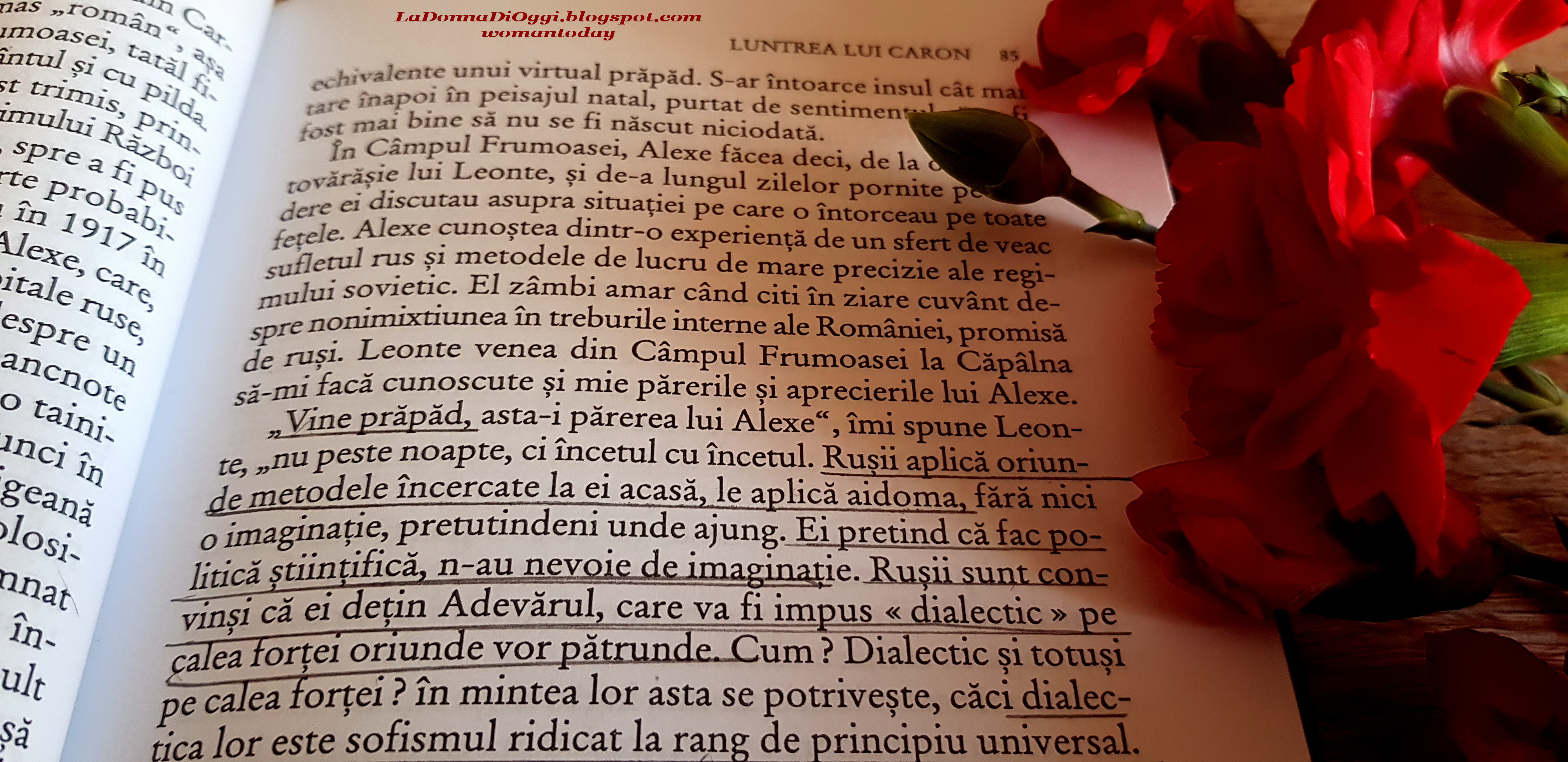
Luntrea lui Caron de Lucian Blaga - recenzie de carte / Il traghetto di Caronte di Lucian Blaga - recensione letteraria / Charon's Ferry by Lucian Blaga - book review


Dragi cititori,

Articolul de astazi trateaza unul din cele mai importante opere ale literaturii romanesti si anume romanul Luntrea lui Caron al poetului si filosofului Lucian Blaga. Cum probabil stiti, acest roman a facut parte timp de decenii din “literatura de sertar” a poporului nostru datorita limitarilor si interdictiilor arbitrare si nesabuite ale regimului comunist, fiind publicat postum, la 30 de ani de la moartea scriitorului.

In ciuda aspectului autobiografic, naratiunea este facuta la prima persoana, autorul se divide in doua personaje, poetul Axente Creanga si filosoful Leonte Patrascu pentru a surprinde in totalitate complexitatea vietii sale, Luntrea lui Caron este in esenta si un roman istoric intrucat zugraveste cu precizie uluitoare tumultul schimbarilor relative sfarsitului celui de-al doilea razboi mondial si instaurarii regimului comunist in Romania. Lucian Blaga surprinde metodic in toate componentele sale sosirea rusilor, promisii salvatori ai natiunii care prin manevre destabilizante creaza haos, teroare, nevoi pentru a propune in final un sistem materialistic, redundant si repetitiv in care constiinta este anulata si singurul organ de referinta ramanand stomacul. Multumita unor personaje diametral opuse, precum Alexe Pacurariu, intelectual burghez si erou in conflictele cu rusii, si Simion Barda, tanar scriitor de orientare marxista, fenomenul instaurarii este suprins in toata complexitatea retelelor create. In ciuda entuziasmului cu care Simion Barda asteapta aceste schimbari, nici “ochelarii de capastru” cu care regimul doteaza fiecare nou element al organismului, nu pot ascunde realitatea faptelor, o cursa a dezadaptatiilor social, a frustratilor si infometatiilor care va sfarsi contaminand intreaga natiune. In final, recunostiinta unui comunist se va manifesta doar prin punerea pe “linie moarta” spre diferenta de toti ceilalti cetateni “dotati” cu ceva agoniseli, experiente, functii care au sfarsit in inchisori sau "voluntari" la munca fortata. 

Intr-o perioada in care informatiile erau limitate, situatia era atat de disfunctionala incat stiri despre soarta svabilor din Romania, a fostilor functionari sau a cetatenilor care nu se adecvau tiparului, ieseau la iveala cu furia oarba pe care doar frica o poate alimenta. In aceste contexte Lucian Blaga introduce personaje pitoresti care dau culoare romanului si i-l anima, personaje precum Octavia si sotul ei, Popa Vasile, brodnicii ce asista  lumea in perindarea peste Mures, senzuala Ana Rares si adolescentinul ei sot, doamna Marga si satenii de la Capalna care croiesc universul acestui roman, contribuind la nararea aspectului politic si istoric sau fiind elemente cheie in povestile de dragoste si in poetica acestei lucrari. Dezvoltarea unui univers romantic in paralel cu evenimentele istorice si cu adevarate tratate de filozofie, stau ca marturie de neragaduit a talentului acestui scriitor roman. 

Lucian Blaga fusese numit pentru premiul Nobel de catre intelectualii epocii dar nebeneficiind de sustinerea guvernului sau intrucat personaj reactionar, i s-a negat aceasta recunoastere. Figura sa publica si creatiile precedente l-au salvat, asemeni altor oameni de seama, de la inchisori, tortura si moarte intrucat regimul nu dorea sa creeze martiri ci doar automate care raspund la comenzi.

Capacitatea lui Lucian Blaga de a crea figuri de stil este uimitoare, la fiecare pagina poeziile sale se contureaza in strofe sau pur si simplu astern drumul unor creatii, unor metafore revelatoare. In acest sens doresc sa mentionez metafora pastorului de lupi care isi ascunde si isi trece ciurda peste Mures nestingherit.

Luntrea lui Caron nu este doar o marturie, nu este doar un roman istoric ci este si un tratat de filozofie. In paginile sale gasim analize elaborate pe problematici politice, precum tratatul de la Ialta prin care occidentul a devenit unealta de expansiune a comunismului, religie, bogomilism, erezii, metamorfoza pacatului stramosesc patriotism, originea limbii romane si culminand cu analiza metamorfozei om – divinitate. Luntrea lui Caron este in acelasi timp punct de plecare pentru analize si reflectii elaborate precum si tratat bine structurat si elaborat de filosofie. Luntrea lui Caron e aproape un compendiu de cunoastere si din acest motiv lectura sa este un act indatorat.


ITALIANO

Carissimi lettori,

L'articolo di oggi riguarda una delle opere più importanti della letteratura rumena, ovvero il romanzo Il traghetto di Caronte, del poeta e filosofo Lucian Blaga. Come forse saprete, questo romanzo ha fatto parte per decenni della "letteratura da cassetto" del nostro popolo a causa delle limitazioni e dei divieti arbitrari e sconsiderati del regime comunista e viene quindi pubblicato postumo, 30 anni dopo la morte dello scrittore. 

Nonostante l'aspetto autobiografico, la narrazione è fatta in prima persona, l'autore è diviso in due personaggi, il poeta Axente Creanga e il filosofo Leonte Patrascu per cogliere appieno la complessità della sua vita, Il traghetto di Caronte è essenzialmente un romanzo storico in quanto dipinge con estrema chiarezza il tumulto dei cambiamenti relativi alla fine della seconda guerra mondiale e l'instaurazione del regime comunista in Romania. Lucian Blaga coglie metodicamente in tutte le sue componenti l'arrivo dei russi, promettenti salvatori della nazione che attraverso manovre destabilizzanti creano caos, terrore, per proporre finalmente un sistema materialistico, ridondante e ripetitivo in cui la coscienza è annullata e l'unico organo di riferimento rimasto è lo stomaco. Grazie a figure diametralmente opposte, come Alexe Pacurariu, intellettuale borghese ed eroe nei conflitti con i russi, e Simion Barda, giovane scrittore di orientamento marxista, il fenomeno dell'istaurazione viene sorpreso in tutta la complessità delle reti create. Nonostante l'entusiasmo con cui Simion Barda attende questi cambiamenti, nemmeno gli "occhiali da cavallo" di cui il regime equipaggia ogni nuovo elemento del suo organico, non possono nascondere la realtà dei fatti, una corsa di persone socialmente disadattate, frustrati e famelici che finirà per contaminare l'intera nazione. Alla fine, la gratitudine di un comunista si manifesterà solo mettendo su un "binario morto" a differenza di tutti gli altri cittadini "dotati" di alcuni risparmi, esperienze, posizioni, finiti in carceri o volontari ai lavori forzati. 

In un momento in cui le informazioni erano limitate, la situazione era così disfunzionale che le notizie sul destino degli svevi in ​​Romania, degli ex funzionari o dei cittadini che non si adattavano allo schema, sono venute alla luce con la rabbia cieca che solo la paura può alimentare. In questi contesti Lucian Blaga introduce personaggi pittoreschi che danno colore al romanzo e lo animano, personaggi come Octavia e suo marito, Prete Vasile, i barcaioli che assistono il mondo nel peregrinaggio su Mures, la sensuale Ana Rares e il marito dall’aspetto adolescente, la signora Marga ei paesani che plasmano l'universo di questo romanzo, contribuendo alla narrazione dell'aspetto politico e storico o essendo elementi chiave nelle storie d'amore e nella poetica di quest'opera. Lo sviluppo di un universo romantico in parallelo con gli eventi storici e con veri trattati di filosofia, rappresentano una preziosa testimonianza del talento di questo scrittore rumeno. Lucian Blaga all'epoca era stato nominato per il Premio Nobel dagli intellettuali europei, ma poiché non godeva del sostegno del suo governo in quanto figura reazionaria, gli fu negato questo riconoscimento. Alla fine, essere un personaggio pubblico e le precedenti creazioni lo salvarono, come successe ad altre persone importanti, dalle carceri, dalle torture e dalla morte perché il regime non voleva creare martiri ma solo automi che rispondono agli ordini.

La capacità di Lucian Blaga di creare figure stilistiche è sorprendente, in ogni pagina le sue poesie sono tratteggiate in strofe o semplicemente tracciano il percorso di altre creazioni, di alcune metafore rivelatrici. In questo senso vorrei citare la metafora del pastore di lupi che nasconde e passa il suo gregge su Mures senza ostacoli.

Il traghetto di Caronte non è solo una testimonianza, non è solo un romanzo storico ma anche un trattato di filosofia. Nelle sue pagine troviamo analisi elaborate su questioni politiche, come il Trattato di Yalta con il quale l'Occidente divenne strumento per l'espansione del comunismo, religione, bogomilismo, eresie, metamorfosi del peccato ancestrale, patriottismo, origine della lingua romena e culminando nell'analisi della metamorfosi uomo-divinità. La barca di Caron è allo stesso tempo un punto di partenza per elaborate analisi e riflessioni, nonché un ben strutturato ed elaborato trattato di filosofia. Il romanzo “Il traghetto di Caronte” è quasi un compendio di conoscenze e per questo motivo, leggerlo è un dovere.


ENGLISH

Dear readers,

Today's article is about one of the most important works of Romanian literature, namely the novel Charon's Ferry by the poet and philosopher Lucian Blaga. As you may know, this novel has been part of the "drawer literature" of our people for decades due to the arbitrary and thoughtless limitations and prohibitions of the communist regime and is therefore published posthumously, 30 years after the writer's death. 

Despite the autobiographical aspect, the narration is done in the first person, the author is divided into two characters, the poet Axente Creanga and the philosopher Leonte Patrascu, to fully grasp the complexity of his life, Charon's Ferry is essentially a historical novel as it paints with extreme clarity the tumult of the changes related to the end of the Second World War and the establishment of the communist regime in Romania. Lucian Blaga methodically captures in all its components the arrival of the Russians, promising saviors of the nation who through destabilizing maneuvers create chaos, terror, to finally propose a materialistic, redundant and repetitive system in which conscience is nullified and the only organ of reference left, is the stomach. Thanks to diametrically opposed figures, such as Alexe Pacurariu, bourgeois intellectual and hero in the conflicts with the Russians, and Simion Barda, a young writer of Marxist orientation, the phenomenon of the establishment is surprised in all the complexity of the networks created. Despite the enthusiasm with which Simion Barda awaits these changes, not even the "horse glasses" with which the regime equips each new element of its staff can hide the reality of the facts, a race of socially maladjusted, frustrated and hungry people that will end up contaminating the entire nation. In the end, the gratitude of a communist will only manifest itself by putting on a "dead-end track", unlike all the other citizens "gifted" with some savings, experience, positions, that end up in prison or “volunteering” for forced labor. 

At a time when information was limited, the situation was so dysfunctional that news about the fate of the Swabians in Romania, of former officials or citizens who did not fit the pattern, came to light with the blind rage that only fear can fuel. In these contexts Lucian Blaga introduces picturesque characters who give color to the novel and animate it, characters like Octavia and her husband, Priest Vasile, the boatmen who assist the world in the pilgrimage on Mures, the sensual Ana Rares and her adolescent-looking husband, Mrs. Marga and the villagers who shape the universe of this novel, contributing to the narration of the political and historical aspect, or being key elements in the love stories and poetics of this novel. The development of a romantic universe in parallel with historical events and with real philosophical treatises, represent a precious testimony of the talent of this Romanian writer. Lucian Blaga had been nominated for the Nobel Prize by European intellectuals at the time, but since he did not enjoy the support of his government as a reactionary figure, he was denied this recognition. In the end, his previous creations and being a public figure, saved him, as happened to other important people, from prisons, torture and death because the regime did not want to create martyrs but only automatons that respond to orders.

Lucian Blaga's ability to create stylistic figures is surprising, on each page his poems are outlined in stanzas or simply trace the path of other creations, of some revealing metaphors. In this sense I would like to mention the metaphor of the wolf shepherd who hides and passes his flock on Mures without obstacles.

Charon's Ferry is not only a testimony, it is not only a historical novel but also a philosophical treatise. In its pages we find elaborate analyses on political issues, such as the Yalta Treaty with which the West became an instrument for the expansion of communism, religion, Bogomilism, heresies, metamorphosis of ancestral sin, patriotism, origin of the Romanian language and culminating in the analysis of the metamorphosis man-divinity. Charon's Ferry is at the same time a starting point for elaborate analyses and reflections, as well as a well-structured and elaborate treatise on philosophy. The novel "Caron's Boat" is almost a compendium of knowledge and for this reason, reading it is a must.


Pentru a realiza aceasta recenzie am citit in limba romana, romanul Luntrea lui Caron, de Lucian Blaga, 583 pagine, editura Humanitas, 2019, ISBN 978-973-50-6558-4

Per scrivere questa recensione ho letto in rumeno il romanzo Il traghetto di Caronte, di Lucian Blaga, 583 pagine, casa editrice Humanitas, 2019, ISBN 978-973-50-6558-4

To write this review, I read in Romanian, the novel Charon's Ferry, by Lucian Blaga, 583 pages, Humanitas publishing house, 2019, ISBN 978-973-50-6558-4


Disclaimer e premesse / Disclaimer and premises

IT: Questo post non ha scopi commerciali e non incoraggia vendite, denominazioni, immagini ed eventuali link presenti sono solo a scopo informativo. Le immagini ritraggono un prodotto acquistato regolarmente che ho valutato in quanto consumatore. Questo post è di mia completa creazione per quanto riguarda contenuti, foto e idee espresse. Prima di usare qualsiasi parte di questo post siete pregati di contattarmi e nel caso vi abbia ispirato per altre creazioni, vi chiedo cortesemente di menzionare la fonte.

ENG: This post has no commercial purposes and does not encourage sales, names, pictures and eventual links are present only for an informative purpose. The images depict a regularly purchased product that I have evaluated as a consumer. This post is of my entire creation as for contents, photos and expressed ideas. Before using any part of it, you need to contact me and in case it inspired you for other creations, I gently ask you to mention the source.

giovedì 7 novembre 2024

Accabadora di Michela Murgia - recensione di un capolavoro / Accabadora by Michela Murgia - review of a masterpiece


Carissimi amici e lettori,

Eccomi tornata con una nuova recensione letteraria e questa volta vi parlo di un romanzo molto importante di una scrittrice Italiana che ci ha lasciati da poco. Il romanzo è Accabadora e la scrittrice, come probabilmente avete già indovinato, è la compianta Michela Murgia. Questa è la prima opera che leggo di questo autore e lasciatemelo dire, non sarà sicuramente l'ultimo o l'unico.

Il tema principale del romanzo Accabadora è la morte perché l'accabadora (dallo spagnolo acabar = finire) è colei che mette fine, colei che termina. Gli aspetti principali trattati in questo romanzo riguardano la vita è tutto quello che comprende l'essere vivo, perciò anche la morte, perché se uno non può decidere quando nascere, potrebbe almeno avere qualcosa da dire su quando morire. Quindi, a questo punto mi vedo costretta a fare un piccolo spoiler in quanto uno dei personaggi principali di questo romanzo, la zia Bonaria fa proprio questo, mette fine alle sofferenze dei moribondi. Sua nipote Maria, adottata in tenera età e cresciuta come figlia, è l'altro personaggio principale di questo romanzo. Ovviamente questo aspetto non è chiaro e non è ovvio sin dall'inizio però ritengo necessario specificarlo immediatamente per attirare da subito la vostra attenzione. Quindi come stavo dicendo abbiamo due personaggi principali femminili, Maria e Tzia Bonaria. Maria Listru nasce con un padre morto, perché suo padre è morto prima che lei nascesse, quindi ella già dalla nascita è più vicina alla morte della maggior parte delle persone. Viene in seguito adottata o in questo caso presa come figlia d'anima, da sua zia Bonaria, una donna che non ha mai avuto figli perché il marito era morto durante la guerra. Il villaggio è infatti pieno di tantissime donne vedove e quindi si può dire che la morte è popolare, quasi un personaggio vero e proprio del romanzo.

L'azione si sviluppa in un ambito rurale in Sardegna nel periodo interbellico del secondo scorso. C'è una grande meticolosità nel descrivere le tradizioni di questa terra, le festività, l'abito, le tradizioni culinarie nonché i principali momenti dei lavori agricoli, in conclusione la vita contadina. L'azione si svolge come dicevo per la maggior parte in Sardegna, ma abbiamo tuttavia un momento in cui il nostro personaggio principale, Maria Listru, lascia la Sardegna per andare a lavorare a Torino, come balia di due ragazzi, figli di una ricca famiglia borghese. La pausa è molto breve ma costituisce un momento cruciale per lo sviluppo del nostro personaggio perché nonostante fosse lontana dagli eventi in Sardegna questo momento riguarda altri eventi importanti della vita. Questa fase è altrettanto importante nello sviluppo del carattere di Maria Listru almeno quanto lo è stata la sua vita in Sardegna.

Il romanzo tratta diversi aspetti della vita a partire dalla nascita, al battesimo, al matrimonio ed in precedenza il corteggiamento, il lavoro fisico, le amicizie gli incidenti, le aggressioni, le malattie e quindi anche la morte, inevitabilmente anche la morte. Quello che Michela Murgia fa in questo romanzo è illustrale come tutti questi eventi sono in realtà delle scelte in quanto è l'individuo a scegliere quando sposarsi e con chi sposarsi, i piatti che vuole mettere a disposizione per i suoi commensali al matrimonio, è lui a scegliere di lavorare o meno, la tipologia di lavoro e perciò quando si trova in sofferenza, può scegliere anche di morire. Quindi questo romanzo non riguarda o non tratta solo il tema della morte, di fatto, il suo tema è soprattutto la scelta. Scelta propria o scelte fatte da altri perché, è qui faccio un altro spoiler, noterete leggendo questo romanzo che la Tzia Bonaria offre i suoi servigi, solo alle persone convinte di voler oltrepassare questa soglia. Quindi sono le persone che scelgono consapevolmente di morire e rifiuta assolutamente di offrire i suoi servigi alle persone che scelgono la morte degli altri per motivi di comodità o comunque per ridurre e la propria sofferenza. Resta memorabile infatti un caso in cui rifiuta di offrire i suoi servigi ad una famiglia che vorrebbe mettere fine alle sofferenze di un anziano, malato, solo perché non è stata una scelta del malato ma una scelta della famiglia.

 Un altro aspetto importante è il dolore e la sofferenza che, in questo caso non finisce sempre con la morte, o almeno non la sofferenza delle persone care perché per loro rimane ancora il lutto che è anch'esso un dolore. C'è infatti un momento in cui Maria e chiede a sua zia quando finisce il lutto e la zia le risponde esso finisce quando il dolore della perdita finisce e continua spiegando che il dolore è nudo e la gente cercando di nascondere il dolore usando i vestiti in lutto.

Accabadora è difatti un romanzo breve, ha solo 163 le pagine e la lettura è facile perché la narrazione è scorrevole e fluente. Nonostante alcuni termini sardi, terminologie tradizioni inusuali l'Accabadora non è sicuramente un libro da leggere sulla spiaggia o con mentre si prende il caffè. L'Accabadora è un libro che fa riflettere, che stimola l'autoanalisi accompagnata da un'importante carica affettiva in quanto il tema della morte non è un tema che si affronta a cuor leggero. In conclusione, oltre a dirvi che questo è sicuramente un libro che merita essere letto voglio anche avvertirvi che è molto importante essere preparato e soprattutto scegliere il momento adatto per leggere un romanzo di questo calibro.


ENGLISH

Dear friends and readers,

Here I am back with a new literary review and this time I am talking about a very important novel by an Italian writer who recently left us. The novel is Accabadora and the writer, as you probably already guessed, is the late Michela Murgia. This is the first work I have read by this author and let me tell you, it will certainly not be the last or the only one.

The main theme of the novel Accabadora is death because the accabadora (from the Spanish acabar = to finish) is the one who puts an end, the one who finishes. The main aspects covered in this novel concern life and everything that includes being alive, therefore also death, because if one cannot decide when to be born, he could at least have something to say about when to die. So, at this point I feel the need to make a small spoiler because one of the main characters of this novel, Aunt Bonaria does just that, she puts an end to the suffering of the dying. Her niece Maria, adopted at a young age and raised as a daughter, is the other main character of this novel. Obviously, this aspect is not clear and it is not clear from the beginning but I think it is necessary to specify it right away to immediately attract your attention. So, as I was saying we have two main female characters, Maria and Tzia Bonaria. Maria Listru was born with a dead father, because her father died before she was born, so from birth she is closer to death than most people. She is later adopted or in this case taken as a soul daughter, by her aunt Bonaria, a woman who never had children because her husband died during the war. The village is in fact full of many widowed women and so we can say that death is popular, almost a real character in the novel.

The action develops in a rural setting in Sardinia in the interwar period of the last century. There is great precision in describing the traditions of this land, the festivities, the clothing, the culinary traditions as well as the main moments of agricultural work, in conclusion the peasant life. The action takes place as I said for the most part in Sardinia, but we do have a moment in which our main character, Maria Listru, leaves Sardinia to go and work in Turin, as a wet nurse to two boys, sons of a rich bourgeois family. The pause is very short but it constitutes a crucial moment for the development of our character because although she was far from the events in Sardinia this moment concerns other important events in her life. This phase is just as important in the development of Maria Listru's character at least as it was her life in Sardinia.

The novel deals with different aspects of life starting from birth, to baptism, to marriage and previously courtship, physical work, friendships, accidents, assaults, illnesses and therefore also death, inevitably death too. What Michela Murgia does in this novel is illustrate how all these events are actually choices since it is the individual who chooses when to get married and who to get married to, the dishes he wants to make available for his wedding guests, he is the one who chooses to work or not, the type of work and therefore when he finds himself in suffering, he can also choose to die. Therefore, this novel does not concern or deal only with the theme of death, in fact, its theme is above all the choice. One's own choice or choices made by others because, and here I make another spoiler, you will notice reading this novel that Tzia Bonaria offers her services only to people convinced of wanting to cross this threshold. So, they are people who consciously choose to die and she absolutely refuses to offer her services to people who choose the death of others for reasons of convenience or in any case to reduce their own suffering. In fact, a memorable case remains in which she refuses to offer her services to a family that would like to put an end to the suffering of an elderly, sick person, only because it was not the patient's choice but the family's choice.

Another important aspect is the pain and suffering that, in this case, does not always end with death, or at least not the suffering of loved ones because for them there is still mourning which is also a pain. In fact, there is a moment in which Maria asks her aunt when mourning ends and her aunt replies that it ends when the pain for the loss ends and continues explaining that pain is naked and people try to hide their pain by using mourning clothes.

Accabadora is in fact a short novel, it has only 163 pages and the reading is easy because the narration is smooth and fluent. Despite some Sardinian terms, unusual traditional terminology, Accabadora is definitely not a book to read on the beach or while drinking coffee. Accabadora is a book that makes you think, that stimulates self-analysis accompanied by an important emotional charge because the theme of death is not a theme that can be approached light-heartedly. In conclusion, in addition to telling you that this is definitely a book that deserves to be read, I also want to warn you that it is very important to be prepared and above all choose the right time to read a novel of this caliber.


Per realizzare questa recensione ho letto in Italiano il libro Accabadora di Michela Murgia, casa editrice Einaudi, collana Super ET, 2014, ISBN 978-88-06-22189-8

To write this review I read in Italian the book Accabadora by Michela Murgia, Einaudi publishing house, Super ET series, 2014, ISBN 978-88-06-22189-8


Disclaimer e premesse / Disclaimer and premises

IT: Questo post non ha scopi commerciali e non incoraggia vendite, denominazioni, immagini ed eventuali link presenti sono solo a scopo informativo. Le immagini ritraggono un prodotto acquistato regolarmente che ho valutato in quanto consumatore. Questo post è di mia completa creazione per quanto riguarda contenuti, foto e idee espresse. Prima di usare qualsiasi parte di questo post siete pregati di contattarmi e nel caso vi abbia ispirato per altre creazioni, vi chiedo cortesemente di menzionare la fonte.

ENG: This post has no commercial purposes and does not encourage sales, names, pictures and eventual links are present only for an informative purpose. The images depict a regularly purchased product that I have evaluated as a consumer. This post is of my entire creation as for contents, photos and expressed ideas. Before using any part of it, you need to contact me and in case it inspired you for other creations, I gently ask you to mention the source.


venerdì 11 ottobre 2024

Bassure di Herta Muller - recensione letteraria / Nadirs by Herta Muller - book review / Tinuturile joase de Herta Muller - recenzie de carte


Ciao carissimi amici e lettori,

Oggi ritorno finalmente con una recensione letteraria e anche stavolta recensisco un’altra opera di uno scrittore vincitore del premio Nobel per la letteratura. L’autore è la scrittrice, saggista e poetessa tedesca, nata in Romania, Herta Muller e il libro è la sua opera di debutto, Bassure (Niederungen titolo originale in tedesco). Bassure è una raccolta di racconti incentrata sulla sua infanzia a Nitchidorf, un piccolo comune composto da tre villaggi, nel distretto Timis, nella regione storica Banat. La sua infanzia passata nel periodo dopo la seconda guerra mondiale, descrive un periodo di povertà e privazioni comune a molti altri paesi d'Europa, ma i decenni successivi, gli anni della sua crescita e maturazione vengono trascorsi sotto il sigillo di un regime oppressivo, severo e umiliante e lasceranno la loro impronta profonda sulla scrittura e lo stile creativo di Herta Muller.

Per essere il primo libro di un autore, Bassure stupisce per la complessità della retorica, la poetica della narrazione e la forza della lirica. Si delinea già quello che è attualmente lo stile di Herta Muller, emblematico, metaforico e carico di contenuto. Questo libro in particolare descrive non solo il suo vissuto nella Romania comunista ma riproduce fedelmente la sfera emotiva di una giovane donna che inizia a conoscere il mondo tra l'oppressione e il desiderio di affermazione. Riferimenti al passato da soldato SS del padre e la sconfitta delle Germania nazista si celano dietro i capitoli Pere marce e A quel tempo in maggio mentre il tradimento del padre nasconde non solo quello che viene descritto come un rapporto di natura sessuale ma anche la punizione della madre con la reclusione in un lager riformatorio nell'unione sovietica come reazione del regime comunista verso i rumeni tedeschi che hanno combattuto con i nazisti. Grazie alla sua retorica, Herta Muller coglie l'abuso di un regime ignominioso e descrive la violenza della paura raccontando eventi banali con parole a portata di mano di tutti. Emblematico in questo senso è il capitolo Giorno feriale, quando tutto va bene perché tutto all'incontrario.

Tutto questo, forse, non risulterà evidente alla prima lettura, perché la maggior parte delle volte il senso di una poesia non risulta chiaro subito, ma lo fa alla seconda rilettura, o forse  alla terza volta, se non si conoscono gli avvenimenti. E non appena se ne comprende il significato, l'emozione della scoperta estasia il lettore, come se si trovasse davanti a un quadro di Picasso.

È vero, non è facile leggere Herta Muller, ma d'altronde non è facile leggere nessun scrittore insignito con il premio Nobel. Detto ciò, se ci armiamo di pazienza e disponibilità ad informarci e aprire la nostra mente, scopriremo il modo più sorprendente e genuino di ritrarre la paura e il trauma e descrivere il peccato, il tempo e la vergogna. Questa raccolta di racconti è come gli altri libri della Muller, una prosa poetica, perciò va letta come se fosse una poesia, restando attenti a cogliere tutte le figure retoriche. La qualità delle metafore è eccelsa, la scrittura di Herta Muller è carica e sublime allo stesso tempo, perciò io vi consiglio di non perdervi questo libro se siete amanti di rompicapi e di poesia.


ENGLISH

Hello dear friends and readers,

Today I finally return with a literary review and once again I review another work by a writer who won the Nobel Prize for Literature. The author is Romanian-born German writer, essayist and poet Herta Muller and the book is her debut work, Nadirs. Nadirs is a collection of short stories focusing on her childhood in Nitchidorf, a small municipality made up of three villages, in the Timis district, in the historical region Banat. His childhood spent in the period after the Second World War, describes a period of poverty and deprivation common to many other European countries, but the following decades, the years of his growth and maturation are spent under the seal of an oppressive, severe and humiliating regime and will leave their profound imprint on Herta Muller's writing and creative style.

For being the first book by an author, Bassure amazes with the complexity of the rhetoric, the poetics of the narrative and the strength of the lyric. What is currently Herta Muller's style is already emerging, emblematic, metaphorical and full of content. This book in particular describes not only her experience in communist Romania but faithfully reproduces the emotional sphere of a young woman who begins to understand the world between oppression and the desire for affirmation. References to the father's past as an SS soldier and the defeat of Nazi Germany are hidden behind the chapters Rotten Pears and That Time in May while the father's betrayal hides not only what is described as a sexual relationship but also the punishment of mother with imprisonment in a reformatory concentration camp in the Soviet Union as a reaction of the communist regime towards the German Romanians who fought with the Nazis. Thanks to her rhetoric, Herta Muller captures the abuse of an ignominious regime and describes the violence of fear by recounting banal events with words within everyone's reach. Emblematic in this sense is the chapter Weekday, when everything is fine because everything is backwards.

All this perhaps will not be obvious on the first reading, as more often than not, the meaning of a poem does not become clear immediately but upon rereading a second and perhaps even a third time, if the events are not known. And as soon as the meaning is understood, the emotion of discovery enraptures the reader, as if he were in front of a painting by Picasso.

It's true, it's not easy to read Herta Muller, but then again, it's not easy to read any writer awarded the Nobel Prize. That said, if we arm ourselves with patience and a willingness to inform ourselves and open our minds, we will discover the most surprising and genuine way to portray fear and trauma and describe sin, time and shame. This collection of short stories is like Muller's other books, a poetic prose, therefore it should be read as if it were a poem, being careful to grasp the all the rhetorical figures. The quality of the metaphors is excellent, Herta Muller's writing is charged and sublime at the same time, so I advise you not to miss this book if you love puzzles and poetry.


ROMANA

Dragi prieteni si cititori,

Astăzi revin in sfarsit cu o recenzie literară și revăd încă o dată o altă lucrare a unui scriitor care a câștigat Premiul Nobel pentru Literatură. Autoarea este scriitoarea, eseista și poeta germană de origine română Herta Muller, iar cartea este opera ei de debut, Tinuturile joase. Tinuturile joase este o colecție de nuvele care vizează copilăria sa din Nitchidorf, un mic municipiu format din trei sate, in judetul Timiș, din regiunea istorică Banat. Copilăria sa petrecută în perioada de după cel de-al Doilea Război Mondial, descrie o perioadă de sărăcie și deprivare comună multor altor țări europene, dar următoarele decenii, anii creșterii și maturizării sale, petrecuți sub pecetea unui regim opresiv, sever și umilitoar și își vor lăsa amprenta profundă asupra scrisului și stilului creativ al Hertei Muller.

Fiind prima carte a unui autor, Bassure uimește prin complexitatea retoricii, poetica narațiunii și puterea liricii. Ceea ce este în prezent stilul Hertei Muller este deja în curs de dezvoltare, emblematic, metaforic și plin de conținut. Această carte în special descrie nu doar experiența ei în România comunistă, ci reproduce cu fidelitate sfera emoțională a unei tinere care începe să înțeleagă lumea dintre opresiune și dorința de afirmare. Referirile la trecutul tatălui ca soldat SS și la înfrângerea Germaniei naziste sunt ascunse în spatele capitolelor Rotten Pears și That Time in May, în timp ce trădarea tatălui ascunde nu numai ceea ce este descris ca o relație sexuală, ci și pedeapsa mamei cu închisoarea în un lagăr de concentrare reformator din Uniunea Sovietică ca reacție a regimului comunist față de românii germani care au luptat cu naziștii. Datorită retoricii sale, Herta Muller surprinde abuzul unui regim ignominios și descrie violența fricii, relatând întâmplări banale cu cuvinte la îndemâna tuturor. Emblematic în acest sens este capitolul Ziua săptămânii, când totul este bine pentru că totul este invers.

Toate acestea, poate, nu vor fi evidente la prima lectură, deoarece de cele mai multe ori sensul unei poezii nu devine clar imediat, ci la recitirea a doua și poate chiar si a treia oară, dacă evenimentele nu sunt cunoscute. Și de îndată ce sensul este înțeles, emoția descoperirii îl extazia pe cititor, de parcă s-ar afla în fața unui tablou de Picasso.

Este adevărat, nu este ușor să o citești pe Herta Muller, dar, din nou, nu este ușor să citești niciun scriitoar laureat cu Premiul Nobel. Acestea fiind spuse, dacă ne înarmam cu răbdare și dorința de a ne informa și de a ne deschide mințile, vom descoperi cel mai surprinzător și autentic mod de a reda frica și trauma și de a descrie păcatul, timpul și rușinea. Această colecție de nuvele este ca și celelalte cărți ale lui Muller, o proză poetică, de aceea trebuie citită ca și cum ar fi o poezie, având grijă a intelege toate figurile retorice. Calitatea metaforelor este excelentă, scrisul Hertei Muller este încărcat și sublim în același timp, așa că vă sfătuiesc să nu ratați această carte dacă iubiți puzzle-urile și poezia.


Per questa recensione ho letto il libro Bassure di Herta Muller, editore Feltrinelli, collana I Narratori, settembre, 2010, ISBN 978-88-07-01817-6

For this review I read in Italian, the book Nadirs by Herta Muller, Feltrinelli publisher, I Narratori series, September 2010, ISBN 978-88-07-01817-6

Pentru aceasta recenzie am citit in limba italiana cartea Tinuturile joase de Herta Muller, editura Feltrinelli, seria Naratorii, septembrie 2010, ISBN 978-88-07-01817-6


Disclaimer e premesse / Disclaimer and premises

IT: Questo post non ha scopi commerciali e non incoraggia vendite, denominazioni, immagini ed eventuali link presenti sono solo a scopo informativo. Le immagini ritraggono un prodotto acquistato regolarmente che ho valutato in quanto consumatore. Questo post è di mia completa creazione per quanto riguarda contenuti, foto e idee espresse. Prima di usare qualsiasi parte di questo post siete pregati di contattarmi e nel caso vi abbia ispirato per altre creazioni, vi chiedo cortesemente di menzionare la fonte.

ENG: This post has no commercial purposes and does not encourage sales, names, pictures and eventual links are present only for an informative purpose. The images depict a regularly purchased product that I have evaluated as a consumer. This post is of my entire creation as for contents, photos and expressed ideas. Before using any part of it, you need to contact me and in case it inspired you for other creations, I gently ask you to mention the source.


mercoledì 15 maggio 2024

Un romanzo edificante - recensione Il giovane Holden di J. D. Salinger / An edifying novel - review of Young Holden by J. D. Salinger


Carissimi amici e lettori,

Oggi ritorno con una nuova recensione e il libro che intendo recensire stavolta è un classico della letteratura americana e universale. Il romanzo s’intitola Il Giovane Holden e l’autore è lo scrittore statunitense Jerome David Salinger. Vista la difficoltà di catturare ogni angolazione semantica e culturale in lingua italiana, The Catcher in the Rye (traduzione letterale per Il prenditore nella segale) ha visto la luce editoriale dopo diversi tentativi, inizialmente con il titolo Vita da Uomo, concludendosi con il ben noto Il Giovane Holden. Dal titolo italiano si evince facilmente il personaggio principale e anche la natura formativa di questo romanzo, cioè il percorso che un giovane intraprende per diventare adulto. Come nella maggior parte delle sue opere, il personaggio principale, in questo caso Holden Caufield, è un giovane disadattato, anticonformista, depresso ed emotivo, un giovane che cercando il suo posto nel mondo, entra in conflitto con tutti coloro con cui interagisce. Il romanzo si sviluppa come una narrazione in prima persona, un racconto realizzato dalla stanza di un ospedale per malati di tubercolosi e ripercorre le facende susseguite all’espulsione di Holden Caulfield dal college fino al suo ricovero nella clinica. Non essendo la sua prima espulsione e temendo la reazione dei genitori, Holden decide di fuggire dal college coinvolgendo nello sviluppo delle sue bravate colleghi, professori, persone appena conosciute, vecchi amici e familiari. Cosi veniamo a conoscenza dei rapporti contrastanti che ha con i suoi colleghi di stanza, Ackley e Stradlater, dell’ammirazione conclusa in delusione che ha verso Spencer, il suo professore di storia, dello stupore suscitato dal suo ex insegnante di inglese, il professore Antolini, delle sue interazioni volutamente fasule e superficiali con la sua vecchia amica Sally Hayes, delle conversazioni esplorative con Carl Luce, un ragazzo più maturo, dotto ed esperto, del suo tentativo goffo di rincorrere ai servizi di una prostituta, dei suoi ricordi nostalgici che coinvolgono la sua amica d’infanzia Jane Gallagher nonché dei rapporti affettuosi, genuini e protettivi che lo legano alla sorellina, Phoebe Caulfield. Quasi ognuno di questi rapporti nasconde una situazione di conflitto con un finale sfortunato per il nostro eroe ma, sono proprio questi conflitti, questi rapporti burrascosi a formare, consolidare il carattere del nostro giovane e prepararlo per il mondo da adulto che lo attende. Viste singolarmente, ognuna di queste situazioni vengono sperimentate dai giovani in diverse fasi della loro evoluzione, l’autore concentrando il numero, la successione e l’intensità di questi momenti per illustrare le vicisitudini che comportano. In certi momenti Holden potrebbe sembrare un ragazzo problematico, con caratteristiche sociopatiche e personalità Borderline ma in realtà questa sensazione è data dal cumulo di situazioni conflittuali che lo vedono come protagonista. Holden in realtà è il prodotto di sintesi di diversi processi conflittuali intesi a rappresentare i momenti critici che tutti i giovani adolescenti affrontano nel loro percorso verso la vita da adulto. Holden dunque rappresenta la gioventù alla stregua con un processo edificante e perciò racchiude tutti i loro difetti e tutti i loro conflitti. Ognuno di questi giovani è alla ricerca di un qualcosa che possa salvarli, proteggerli, prepararli, alla ricerca di un ricevitore o un prenditore che possa acchiapparli prima di cascare in un burrone. Lo spirito protettivo nasce dall’osservazione delle ingiustizie ma anche dal desiderio di proteggere la sorellina da un destino simile al suo ed è questo sentimento che trasforma Holden in un protettore. Il desiderio di risparmiare a coloro che verranno il tormento delle difficoltà affrontate da se stessi rappresenta lo spirito genitoriale e perciò protettivo.

La narrazione è fluida, scorrevole e piacevolmente cosparsa di espressioni colloquiale e riferimenti alla cultura americana. Alla prima vista potrebbe sembrare un romanzo facile, una lettura leggera ma soffermandoci su quello che si cela dietro ogni personaggio e ogni fatto narrato, scopriamo un universo letterario ricco, che intreccia al suo interno mille sfumature. Il genio di J.D. Salinger si evince proprio da questo, scrivere un romanzo complesso che chiunque possa leggere e capire.


ENGLISH

Dear friends and readers,

Today I return with a new review and the book I intend to review this time is a classic of American and universal literature.  The novel is titled The Catcher in the Rye and the author is the American writer Jerome David Salinger. Given the difficulty of capturing every semantic and cultural angle in the Italian language, The Catcher in the Rye saw the editorial light after several attempts, initially with the title A Man's life, concluding with the well-known Young Holden (literal translation). From the Italian title, the main character and also the formative nature of this novel are easily deduced, that is, the path that a young person undertakes to become an adult. As in most of his works, the main character, in this case Holden Caufield, is a young misfit, nonconformist, depressed and emotional, a young man who, seeking his place in the world, comes into conflict with everyone with whom he interacts. The novel develops as a first-person narrative, a story created from the room of a hospital for tuberculosis patients and traces the events that followed Holden Caulfield's expulsion from college until his hospitalization in the clinic. Since this is not his first expulsion and fearing his parents' reaction, Holden decides to escape from college, involving colleagues, professors, people he has just met, old friends and family members in the development of his shenanigans. Thus we learn of the contrasting relationships he has with his roommates, Ackley and Stradlater, of the admiration that ended in disappointment that he has towards Spencer, his history professor, of the amazement aroused by his former English teacher, Professor Antolini , of his deliberately fake and superficial interactions with his old friend Sally Hayes, of his exploratory conversations with Carl Luce, a more mature, learned and experienced boy, of his clumsy attempt to solicite the services of a prostitute, of his nostalgic memories involving his childhood friend Jane Gallagher as well as the affectionate, genuine and protective relationships that bind him to his little sister, Phoebe Caulfield. Almost each of these relationships hides a conflictual situation with an unfortunate ending for our hero but it is precisely these conflicts, these stormy relationships that form and consolidate the character of our young man and prepare him for the adult world that awaits him. At certain moments Holden might seem like a problematic boy, with sociopathic characteristics and a Borderline personality but in reality this sensation is given by the accumulation of conflicting situations in which he is the protagonist. Holden is actually the synthesis product of several conflictual processes intended to represent the critical moments that all young adolescents face on their path to adult life. Holden therefore represents youth as an edifying process and therefore contains all their defects and all their conflicts. Each of these young people is looking for something that can save them, protect them, prepare them, looking for a receiver or a catcher who can catch them before falling into a ravine. The protective spirit arises from the observation of injustices but also from the desire to protect his little sister from a fate similar to hers and it is this feeling that transforms Holden into a protector. The desire to spare those who come from the torment of the difficulties faced by oneself represents the parental and therefore protective spirit.

The narrative is fluid, flowing and pleasantly sprinkled with colloquialisms and references to American culture. At a first glance, it might seem like an abordable novel, a light read, but by focusing on what lies behind every character and every fact narrated, we discover a rich literary universe, which intertwines within it a thousand nuances. The genius of J.D. Salinger can be seen precisely from this: writing a complex novel that anyone can read and understand.


IT: Per redigere questa recensione, ho letto in italiano il romanzo Il Giovane Holden di J.D. Salinger, collana Super ET Einaudi, 2014, EAN 9788806218188

ENG: In order to write this review, I read in Italian, the novel The Catcher in the Rye by J.D. Salinger, Super ET Einaudi series, 2014, EAN 9788806218188


Disclaimer e premesse / Disclaimer and premises:

IT: Questo post non ha scopi commerciali e non incoraggia vendite, denominazioni, immagini ed eventuali link presenti sono solo a scopo informativo. Le opinioni espresse rappresentano la mia esperienza in quanto lettore e consumatore. Questo post è di mia completa creazione per quanto riguarda contenuti, foto e idee espresse. Prima di usare qualsiasi parte di questo post siete pregati di contattarmi e nel caso vi abbia ispirato per altre creazioni, chiedo cortesemente di menzionare la fonte.

ENG: This post has no commercial purposes and does not encourage sales, names, pictures and eventual links are present only for an informative purpose. The opinions expressed represent my experience as a reader and consumer. This post is of my entire creation as for contents, photos and expressed ideas. Before using any part of it, you need to contact me and in case it inspired you for other creations, I gently ask you to mention the source.


Recommended post

Solo Cose Belle ottobre 2024 parte 1 / Only Beautiful Things October 2024 part 1

ITALIANO   Ciao carissimi amici,  Finalmente riesco a scrivere il post in merito alle cose belle che ho vissuto durante il mese corrente e s...