Visualizzazione post con etichetta libri. Mostra tutti i post

giovedì 1 ottobre 2026

Herzog di Saul Bellow - recensione di libro / Herzog by Saul Bellow - book review


Ciao carissimi amici e lettori,

Oggi recensisco per voi ancora un romanzo di uno scrittore che ha vinto il premio Nobel per la letteratura. Il romanzo s’intitola Herzog e l’autore è Saul Bellow, uno scrittore canadese di origini ebraiche, naturalizzato statunitense. È il primo e unico romanzo di Saul Bellow che io abbia letto fino ad adesso ma ho capito subito che ne leggerò altri perché la sua narrativa autoanalitica, riflessiva e culturalmente ricca, merita essere esplorata in tutte le sue creazioni. Nonostante fossero i romanzi “Il pianeta di Mr. Sammler” e “Il dono di Humboldt” che tra l’altro vinse anche il premio Pulitzer per la narrativa a portarlo a vincere il Nobel, con Herzog, Saul Bellow si cimenta nell’analisi filosofica come punto centrale della narrazione.

Herzog, intitolato con il cognome del suo personaggio principale, Moses Herzog, non è un romanzo ricco di eventi che finiscono per delineare il carattere dei personaggi ma è un romanzo dove la caratteristica riflessiva e l’interrogarsi su questioni filosofiche del protagonista, determina le sue azioni e i suoi rapporti con gli altri personaggi. Herzog è un romanzo epistolare dove le lettere che Moses scrive, costituiscono il fulcro centrale della narrazione. Moses scrive di continuo delle lettere, alla sua prima ex moglie, alle compagnie di assicurazioni, ai filosofi e a chiunque faccia innescare una scintilla nel suo cervello oberato e sfruttato perché è questo quello che Moses fa come lavoro, pensa. Cresciuto in una famiglia di immigrati ebrei russi, con un padre truffatore che aveva sempre le autorità alle sue calcagna, una madre che rinuncia agli onori che riceveva nella Russia zarista per dedicarsi con abnegazione alla famiglia anche attraverso lavori pesanti e degradanti, una matrigna permissiva e dei fratelli con grande fiuto per gli affari, toccava a Moses riscattare il lato riflessivo e analitico dell’esistenza. Moses riflette su tutto, su quello che gli è accaduto, su quello che sta accadendo in tempo reale e su quello che dovrebbe ancora succedere e nelle sue analisi e lettere, interpella anche i grandi filosofi e pensatori del genere umano. La maggior parte delle sue lettere sono costruite su colloqui immaginari con Nietzche, Rilke e Freud e fa riferimento alle teorie di Shopenhauer, Kierkegaard, Spinoza e Confucius per trovare spiegazioni al suo fallimento come marito e padre, alla ricerca della sua identità filosofica e del suo posto nel mondo. La personalità di Moses, anzi, tutto il suo universo personale prende forma grazie a questi interventi autoanalitici, le sue interazioni partono e sono integrate nel loro disegno più grande, più complesso. L’aspetto più importante di questa analisi si preannuncia subito quando all’inizio del romanzo Herzog si chiede se fosse matto e si conclude quando lui finalmente trova risposta, per egli stesso, per suoi fratelli e per tutti gli altri personaggi che interagendo con lui, si sono mai posti questa domanda.

La narrazione predominantemente analitica viene spezzata a tratti dalla tecnica dei flashback grazie alla quale veniamo a scoprire la sua infanzia, i traumi, le violenze, i matrimoni falliti, i figli avuti, i guai con le autorità ed i rapporti con le nuove donne della sua vita. In questa occasione scopriamo il lato romantico di Herzog che si sofferma dolcemente a descrivere i tratti di sua figlia, le interazioni tenere fra i due, la bellezza sconvolgente di Ramona, l’abnegazione di una madre e la gentilezza di una matrigna. Quando parla delle donne della sua vita, Herzog non è mai volgare e l’autore non ricorre alla sessualità per conquistare il suo pubblico. Ognuna di queste donne, persino Madeleine, la seconda ex moglie che lo ha tradito con il suo amico, viene descritta usando i superlativi in riferimento alla loro bellezza, cultura, determinazione, capacità di giudizio e reazione.

Prima di immergermi in questa lettura, mi sono documentata sulla vita e sulle opere dell’autore e cosi ho capito che Herzog comprende diversi elementi autobiografici, ossia entrambi hanno origini ebraiche, entrambi sono cresciuti in Canada da genitori emigrati dalla Russia, entrambi avevano un padre contrabbandiere di alcoolici, avevano vissuto a lungo a Chicago, sono stati divorziati due volte (successivamente l’autore continua a collezionare divorzi e molto probabilmente anche Herzog lo avrebbe fatto, avesse il libro superato le 400 pagine), ed entrambi sono stati traditi da un amico di fiducia che ha avuto una relazione con una delle future ex mogli. Questo aspetto rende il romanzo più facile da leggere in quanto il tocco personale gli da un’aria vissuta il che è molto utile in una creazione di carattere filosofico.

Confesso che non mi è stato facile leggere questo romanzo, forse non ero preparata a tanta introspezione unita a tanti riferimenti filosofici e culturali e credo che devo maturare e crescere ancora un po’ sotto questo aspetto per poter godere fino in fondo della letteratura di Saul Bellow ma so di sicuro che riprenderò questo libro e lo leggerò ancora e ancora perché Herzog è e resterà, uno dei migliori romanzi del secolo scorso.


ENGLISH

Hello dear friends and readers,

Today I am reviewing for you yet another novel by a writer who won the Nobel Prize for Literature. The novel is called Herzog and the author is Saul Bellow, a Canadian writer of Jewish origins, naturalized American. It's the first and only Saul Bellow novel I've read so far but I quickly knew I'll be reading more because his self-analytical, thoughtful, and culturally rich fiction deserves to be explored in all of his creations. Although there were the novels "Mr. Sammler's Planet" and "Humboldt's Gift" which also won the Pulitzer Prize for fiction that led him to win the Nobel, with Herzog, Saul Bellow engages in philosophical analysis as a central focus of the narrative.

Herzog, entitled with the surname of its main character, Moses Herzog, is not a novel full of events that end up outlining the personality features of the characters but it is a novel where the reflective characteristic and the questioning of philosophical questions of the protagonist determine his actions and his relationships with other characters. Herzog is an epistolary novel where the letters that Moses writes form the central focus of the narrative. Moses writes letters all the time, to his first ex-wife, to insurance companies, to philosophers, and to anyone who strikes a spark in his overwhelmed, overworked brain because that's what Moses does for a job, he thinks. Raised in a family of Russian Jewish immigrants, with a fraudster father who always had the authorities on his heels, a mother who renounced the honors she received in tsarist Russia to devote herself selflessly to the family even through hard and degrading work, a permissive step mother and of brothers with great business acumen, it was up to Moses to redeem the reflective and analytical side of existence. Moses meditates on everything, on what happened to him, on what is happening in real time and on what it is still to happen and in his considerations and letters, he also questions the great philosophers and thinkers of mankind. Most of her letters are built on imaginary conversations with Nietzche, Rilke and Freud and he refers to the theories of Shopenhauer, Kierkegaard, Spinoza and Confucius to find explanations for his failure as a husband and father, to search of his philosophical identity and place in the world. Moses' personality, actually, his entire personal universe takes shape thanks to these self-analytical interventions, his interactions start and are integrated into their larger, more complex design. The most important aspect of this analysis is announced immediately when at the beginning of the novel Herzog wonders if he was mad and ends when he finally finds an answer, for himself, for his brothers and for all the other characters who, interacting with him, have they ever asked themselves this question.

The predominantly analytical narration is broken up at times by the flashback technique thanks to which we come to discover his childhood, the traumas, the violence, the failed marriages, the children he had, the troubles with the authorities and the relationships with the new women of his life. On this occasion we discover the romantic side of Herzog who gently lingers in describing the traits of his daughter, the tender interactions between them two, the overwhelming beauty of Ramona, the abnegation of a mother and the kindness of a stepmother. When he talks about the women in his life, Herzog is never vulgar and the author does not resort to sexuality to win over his audience. Each of these women, even Madeleine, his second ex-wife who cheated on him with his friend, is described using superlatives in reference to their beauty, culture, determination, force of reason and response.

Before immersing myself in this reading, I read up on the life and works of the author and thus I understood that Herzog includes several autobiographical elements, that is both have Jewish origins, both grew up in Canada by parents who emigrated from Russia, both had a smuggler father, had lived a long time in Chicago, were divorced twice (the author continues to collect divorces after that, and Herzog most likely would have done so too, had the book exceeded the 400 pages), and both were betrayed by a trusted friend who had an affair with one of the future ex-wives. This aspect makes the novel easier to read as the personal touch gives it a lived-in sensation which is very useful in a philosophical writing.

I confess that it was not easy for me to read this novel, perhaps I was not prepared for so much introspection combined with so many philosophical and cultural references and I believe that I have to mature and grow a little more for that matter to be able to fully enjoy Saul Bellow's literature but I know for sure that I will pick up this book and read it again and again because Herzog is, and will remain, one of the best novels of the last century.


IT: Recensione eseguita in seguito alla lettura in italiano del romanzo HERZOG di SAUL BELLOW – edizione Oscar Moderni, gruppo editoriale MONDADORI, 2017, ISBN 978-88-04-68312-4

ENG: Book reviewed following the reading in Italian of the novel HERZOG by SAUL BELLOW – Oscar Moderni edition, MONDADORI editorial group, 2017, ISBN 978-88-04-68312-4


Disclaimer e premesse / Disclaimer and premises

IT: Questo post non ha scopi commerciali e non incoraggia vendite, denominazioni, immagini, opinioni ed eventuali link presenti sono solo a scopo informativo. Le immagini ritraggono un prodotto acquistato regolarmente che ho valutato in quanto consumatore e lettore. Questo post è di mia completa creazione per quanto riguarda contenuti, foto e idee espresse. Prima di usare qualsiasi parte di questo post siete pregati di contattarmi e nel caso vi abbia ispirato per altre creazioni, vi chiedo cortesemente di menzionare la fonte.

ENG: This post has no commercial purposes and does not encourage sales, names, pictures, opinions and eventual links are present only for an informative purpose. The images depict a regularly purchased product that I have evaluated as a consumer and reader. This post is of my entire creation as for contents, photos and expressed ideas. Before using any part of it, you need to contact me and in case it inspired you for other creations, I gently ask you to mention the source.


giovedì 26 marzo 2026

Sconosciute di Patrick Modiano - recensione letteraria / Des inconnues by Patrick Modiano - book review


Il libro che recensirò oggi è il romanzo Sconosciute dello scrittore e sceneggiatore francese, premiato nel 2014 con il Premio Nobel per la letteratura, un riconoscimento importante per la sua “arte della memoria con la quale ha evocato i destini umani più inesplicabili e scoperto il mondo della vita nel tempo dell'occupazione”, Patrick Modiano. Modiano nacque nel 1945 da un padre francese di origini ebraico – italiane, con dei trascorsi loschi che lo aiutarono a sopravvivere durante la seconda guerra mondiale, e una madre belga. La figura del padre ha fortemente influito la sua opera in quanto in diverse creazioni, tra queste anche nel libro Sconosciute, inserisce personaggi di discendenza italiana o ebrea che si macchiano di atti disdicevoli e intenzioni riprovevoli. Visto che siamo arrivati a nominare il nostro libro e visto che ho già precisato aspetti importanti che riguardano i personaggi maschili, devo precisare però che i personaggi principali di questo romanzo sono 3 giovane ragazze, ognuna la protagonista di una vicenda traumatica e triste. Nonostante fossero accompagnate da amici, famigliari e conoscenze, queste tre ragazze affrontano da sole le situazioni con cui si confrontano e ne subiscono anche le conseguenze sempre in solitudine.

La prima ragazza si trova immischiata in una situazione piena di ambiguità, conosce diplomati, mafiosi, criminali e s’innamora di un ragazzo il cui vero nome non lo conosce realmente ma che la condiziona nelle scelte che farà in futuro. La seconda ragazza dopo essere vissuta in un internato e un convitto di suore, decide di scapare e vivere la vita lontana dalla monotonia e le regole rigide ma questa decisione la porta ad affrontare situazioni di violenza sessuale e stupro. La terza storia, anche se in apparenza è la più inoffensiva, se non si è un’attivista dei diritti degli animali, nonostante sembrasse inconclusa o almeno più delle altre, in realtà cella diversi traumi che questa ragazza subisce e che si porterà con sé per tutta la vita. Quello che accomuna le tre ragazze è l’età molto giovane e l’aspetto attraente che concorrerà alla causalità di tutti gli eventi che dovranno subire. Non hanno delle doti particolari, provengono da famiglie disagiate e addirittura sono state abbandonate alla mercé dello stato e ognuna di loro ha, a modo suo, una capacità di farsi notare dagli altri e far siche le cose nella loro vita accadano. Per certi versi potrebbero benissimo essere una chiunque di noi e credo che in fin dei conti, questa sia una delle intenzioni dello scrittore, fare in modo che le lettrici s’immedesimassero nelle storie delle sue protagoniste.

La narrazione è scorrevole e accattivante e anche se questo romanzo non è una delle sue opere migliori e sicuramente non è l’opera che le ha valso il Nobel, il suo stile è riconoscibile e rende queste storie, in apparenza semplici, molto interessanti e degne di pause di riflessione. Consiglio questo libro per la sua capacità di catturare l’attenzione e trasportarla attraverso i capitoli in un susseguirsi di momenti di tensione e riflessione.


ENGLISH

The book I'm reviewing today is the novel Des inconnues (original title) by the French writer and screenwriter, who won the 2014 Nobel Prize in Literature, an important recognition for his "art of memory with which he evoked the most inexplicable human destinies and uncovered the world of life during the occupation", Patrick Modiano. Modiano was born in 1945 to a French father of Italian-Jewish origins, with a shady past that helped him survive the Second World War, and a Belgian mother. The figure of his father has greatly influenced his work, as in several of his works, including Unknown, he introduces characters of Italian or Jewish descent who commit unsavory acts and reprehensible intentions. Since we've come to the point of naming our book, and since I've already highlighted important aspects regarding the male characters, I must point out that the main characters in this novel are three young women, each one being the protagonist of a traumatic and sad story. Despite being accompanied by friends, family, and acquaintances, these three girls encounter situations that they face alone and will also suffer the consequences in solitude.

The first girl finds herself caught up in a situation full of ambiguity, meets high school graduates, mobsters, and criminals, and falls in love with a boy whose real name she doesn't actually know, but who influences her future choices. The second girl, after living in a boarding school and a convent, decides to escape and live a life far from monotony and rigid rules, but this decision leads her to face sexual violence and rape. The third story, though seemingly the most harmless—unless you're an animal rights activist—despite appearing unfinished, or at least less so than the others, actually harbors several traumas that this girl endures and will carry with her for the rest of her life. What the three girls have in common is their very young age and attractive appearance, which will contribute to the causality of all the events they will have to endure. They have no special talents, they come from disadvantaged families and were even abandoned to the mercy of the state, and each of them has, in her own way, the ability to stand out to others and make things happen in their lives. In some ways, they could easily be any of us, and I believe that ultimately, this is one of the author's intentions: to make readers identify with the stories of his protagonists.

The narrative is fluid and captivating, and while this novel isn't one of her best works, and certainly not the work that won her the Nobel Prize, her style is recognizable and makes these seemingly simple stories highly interesting and worthy of pause for thought. I recommend this book for its ability to capture your attention and draw you through the chapters in a succession of moments of tension and reflection.


IT: Per redigere questa recensione ho letto in italiano il libro Sconosciute di Patrick Modiano, editore Einaudi, collana Super ET, 2014, EAN 9788806226022

ENG: To write this review I read in Italian the book Sconosciute, original title Des inconnues, by Patrick Modiano, publisher Einaudi, Super ET series, 2014, EAN 9788806226022


Disclaimer e premesse / Disclaimer and premises

IT: Questo post non ha scopi commerciali e non incoraggia vendite, denominazioni, immagini ed eventuali link presenti sono solo a scopo informativo. Le immagini ritraggono un prodotto acquistato regolarmente che ho valutato in quanto consumatore e lettore. Questo post è di mia completa creazione per quanto riguarda contenuti, foto e idee espresse. Prima di usare qualsiasi parte di questo post siete pregati di contattarmi e nel caso vi abbia ispirato per altre creazioni, vi chiedo cortesemente di menzionare la fonte.

ENG: This post has no commercial purposes and does not encourage sales, names, pictures and eventual links are present only for an informative purpose. The images depict a regularly purchased product that I have evaluated as a consumer and reader. This post is of my entire creation as for contents, photos and expressed ideas. Before using any part of it, you need to contact me and in case it inspired you for other creations, I gently ask you to mention the source.

sabato 6 dicembre 2025

Flatlandia di Edwin Abbott Abbott - recensione letteraria / Flatland by Edwin Abbott Abbott - book review


Carissimi lettori,

Nel post di oggi recensirò il libro Flatlandia (Flatland titolo originale) dello scrittore, matematico, teologo e pedagogista britannico Edwin Abbott Abbott. Nacque nel 1838 a Marylebone in una famiglia della media aristocrazia, i suoi genitori erano cugini di primo grado, perciò anche il cognome Abbott Abbott, o come a lui piaceva segnarsi, Abbott². Prese i voti di sacerdote della Chiesa Anglicana nel 1862 e per la prima parte della sua vita, l’autore si dedicò all’insegnamento che abbandonò definitivamente nel 1889 per occuparsi della scrittura ed approfondire i suoi studi. Scrisse più di quaranta libri, dalle opere teologiche, ai manuali scolastici, alle biografie, sino all'opera per cui oggi è maggiormente noto, e che oggi recensirò per voi, Flatlandia. Pubblicata nel 1884 con lo pseudonimo A Square, Flatlandia è un romanzo fantascientifico che narra la vita di un abitante in un ipotetico universo bidimensionale che entra in contatto con l'abitante di un universo tridimensionale.

L’autore divide il racconto in due parti, la prima parte descrive il mondo bidimensionale dove il nostro personaggio, un quadrato, abita e vive e nella seconda parte, lo scrittore descrive l’incontro del nostro personaggio con una sfera che le rivela l’esistenza di una terza dimensione. Come potete già immaginare, il mondo bidimensionale, dove abita il nostro personaggio è un mondo piatto, rigido, i personaggi si muovono solo su un unico piano, e sono divisi in categorie strette ricollegabili alla loro forma. Prima di conoscere la sfera, il nostro quadrato incontra il monarca di linealandia, un mondo dove i personaggi si possono muovere solo in avanti e possono vedere solo chi hanno di fronte e nonostante abbia faticato a spiegare al monarca l’esistenza di flatlandia, un mondo che permetteva il movimento in più direzioni sullo stesso piano, l’apparizione della sfera sconcerta il nostro quadrato, restio, come il monarca d’altronde ad accettare che lo spazio e l’universo comprendessero altre dimensioni oltre a quelle da loro conosciute. Una volta accettata la presenza della sfera e scoperto un mondo tridimensionale nuovo, nel nostro personaggio nasce una vera sete di conoscenza ed inizia ad ipotizzare, per analogia, una quarta dimensione, che, come nei casi precedenti, si scontra con il rifiuto grave della sfera, in questo caso, la creatura superiore, manifestazione comune di ogni essere, che in assenza di prove tangibili, non può accettare di non essere l’apice dell’evoluzione e di non conoscere tutta la verità.

Questo breve romanzo è una deliziosa satira allegorica della società inglese del fine ottocento, l’autore descrivendo infatti Flatlandia come una società rigidamente divisa in gerarchie, suddivisione basata sull'aspetto fisico, nello specifico, sul numero di lati che formano le figure. Nel mondo di Flatlandia un maggior numero di lati, quindi un angolo più largo, viene associato a maggior intelligenza, perciò a scuole migliori e in seguito a lavori migliori, di maggior responsabilità ed in conclusione una posizione migliore nella società. In questo mondo non si può sperare in un'ascesa sociale personale in quanto la forma determina le capacità e qualità ma solo eventualmente un’ascesa della prole, che sviluppando ad ogni generazione un lato in più, avrà la possibilità anche di migliorare la propria posizione sociale. Uno speciale spazio viene riservato alle donne che in quell'universo sono delle linee (oppure punti, nel mondo lineandese), perciò limitate, senza abilità intellettuali e dotate solo di capacità emozionali, assistenziali ed empatiche. Esse sono paragonate ai bambini e vanno perennemente protetti dal mondo esterno. Quando al quadrato viene rivelato il fatto che un alto il livello di società è correlato ad un altresì alto livello di empatia e perciò ad un abbassamento dei concetti e valori materiali, il negazionismo del quadrato non viene sconfitto nemmeno quando viene assillato dall’entusiamo della scoperta o la sete di conoscere, spiegando dunque l’esistenza di preconcetti misogini e razzisti anche fra i luminari di un’epoca. Sono tante le problematiche discusse in questo romanzo, problematiche pertinenti non solo all’epoca vittoriana ma presenti anche nei tempi odierni, soprattutto le limitazioni imposte alle donne in certe aree geografiche, il peso accordato ai valori materiali, la manipolazione attraverso informazioni errate o scarse, lo scoppio e la repressione dei conflitti oppure l’autorevolezza indiscussa accordata a certi capi anche nella società contemporanea. Le implicazioni sociologiche, filosofiche e pedagogiche sono innumerevoli, anche se formulate in un modo estroso ed eclettico perciò considero che questo romanzo non faccia per chiunque. Io stessa ho sospeso la lettura del romanzo ad un certo punto e confesso che la prima parte del romanzo essendo limitata al mondo bidimensionale ed io non una grande intenditrice e simpatizzante della matematica, mi sono trovata in stallo prima di arrivare al capitolo dedicato alla rivoluzione.

Aggiungo soltanto il fatto che nonostante non avesse ricevuto una grande accoglienza all’epoca essendo stampato solo in un paio di edizioni, la sua fama si concretizza dopo la divulgazione della teoria della relatività di Albert Einstein quando l’ipotetica quarta dimensione viene scoperta e teorizzata. Dal punto di vista letterario, Flatlandia può essere visto come un predecessore del romanzo distopico moderno.


ENGLISH

Dear readers,

In today's post I will review the book Flatland by the British writer, mathematician, theologian and pedagogue Edwin Abbott Abbott. He was born in 1838 in Marylebone in a middle-class family, his parents were first cousins, hence the surname Abbott Abbott, or as he liked to sign himself, Abbott². He took vows as a priest of the Anglican Church in 1862 and for the first part of his life, the author devoted himself to teaching which he definitively abandoned in 1889 to devote himself to writing and deepen his studies. He wrote more than forty books, from theological works, to school manuals, to biographies, up to the work for which he is best known today, and which I will review for you today, Flatland. Published in 1884 under the pseudonym A Square, Flatland is a science fiction novel that narrates the life of an inhabitant of a hypothetical two-dimensional universe who comes into contact with an inhabitant of a three-dimensional universe.

The author divides the story into two parts, the first part describes the two-dimensional world where our character, a square, inhabits and lives and in the second part where the writer describes the encounter of our character with a sphere that reveals the existence of a third dimension. As you can already imagine, the two-dimensional world, where our character lives is a flat, rigid world, the characters move only on a single plane, and are divided into narrow categories linked to their shape. Before knowing the sphere, our square meets the monarch of flatland, a world where the characters can only move forward and can only see who is in front of them and despite having struggled to explain to the monarch the existence of flatland, a world that allowed movement in multiple directions on the same plane, the appearance of the sphere disconcerts our square, reluctant, like the monarch, to accept that space and the universe included other dimensions beyond those known to them. Once the presence of the sphere has been accepted and a new three-dimensional world has been discovered, a real thirst for knowledge arises in our character and he begins to hypothesize, by analogy, a fourth dimension, which, as in previous cases, clashes with the serious refusal of the sphere, in this case, the superior creature, common manifestation of every being, which in the absence of tangible evidence, cannot accept not being the pinnacle of evolution and not knowing the whole truth.

This short novel is a delightful allegorical satire of late nineteenth-century English society, the author describing Flatland as a society rigidly divided into hierarchies, a subdivision based on physical appearance, specifically, on the number of sides that form the figures. In the world of Flatland, a greater number of sides, therefore a wider angle, is associated with greater intelligence, therefore with better schools and subsequently with better jobs, with greater responsibility and ultimately a better position in society. In this world, one cannot hope for a personal social ascent because the form determines the abilities and qualities as the only possibly ascension being that of the offspring, who by developing an additional side with each generation, will also have the possibility of improving their social position. A special space is reserved for women who in that universe are lines (or points, in the lineandes world), therefore limited, without intellectual abilities and equipped only with emotional, assistance and empathic abilities. They are compared to children and must be perpetually protected from the outside world. When the square is revealed to the fact that a high level of society is correlated to an equally high level of empathy and therefore to a lowering of material concepts and values, the denialism of the square is not defeated even when it is besieged by the enthusiasm of discovery or the thirst for knowledge, thus explaining the existence of misogynistic and racist preconceptions even among the luminaries of an era. There are many issues discussed in this novel, issues pertinent not only to the Victorian era but also present in today's times, especially the limitations imposed on women in certain geographical areas, the weight given to material values, manipulation through incorrect or scarce information, the outbreak and repression of conflicts or the undisputed authority granted to certain leaders even in contemporary society. The sociological, philosophical and pedagogical implications are innumerable, even if formulated in a whimsical and eclectic way so I consider that this novel is not for everyone. I myself stopped reading the novel at a certain point and I confess that the first part of the novel being limited to the two-dimensional world and me not being a great connoisseur and sympathizer of mathematics, I found myself at a standstill before getting to the chapter dedicated to the revolution.

I will only add that although it did not receive a great reception at the time, being printed in only a couple of editions, its fame materializes after the popularization of Albert Einstein's theory of relativity when the hypothetical fourth dimension is discovered and theorized. From a literary point of view, Flatland can be seen as a predecessor of the modern dystopian novel.


IT: Per realizzare questa recensione ho letto il libro Flatlandia de Edwin A. Abbot, traduzione di Giancarlo Carlotti, editore Feltrinelli, collana Universale Economica Feltrinelli, 2020, ISBN 978-88-07-89346-9

ENG: To write this review I read in Italian the book Flatland by Edwin A. Abbot, translated by Giancarlo Carlotti, publisher Feltrinelli, Universale Economica Feltrinelli series, 2020, ISBN 978-88-07-89346-9


Disclaimer e premesse / Disclaimer and premises:

IT: Questo post non ha scopi commerciali e non incoraggia vendite, denominazioni, immagini ed eventuali link presenti sono solo a scopo informativo. Le opinioni espresse rappresentano la mia esperienza in quanto consumatore. Questo post è di mia completa creazione per quanto riguarda contenuti, foto e idee espresse. Prima di usare qualsiasi parte di questo post siete pregati di contattarmi e nel caso vi abbia ispirato per altre creazioni, chiedo cortesemente di menzionare la fonte.

ENG: This post has no commercial purposes and does not encourage sales, names, pictures and eventual links are present only for an informative purpose. The opinions expressed represent my experience as a consumer. This post is of my entire creation as for contents, photos and expressed ideas. Before using any part of it, you need to contact me and in case it inspired you for other creations, I gently ask you to mention the source.

venerdì 28 febbraio 2025

Le intermittenze della morte di José Saramago - recensione letteraria / Death with Interruptions by José Saramago - book review


Carissimi amici e lettori,

Oggi vorrei recensire un romanzo molto peculiare e intrigante. Si tratta del romanzo “Le intermittenze della morte” dell’autore portoghese vincitore del premio Nobel per la letteratura, Jose Saramago. Precedentemente avevo letto il suo romanzo Cecità ed ero rimasta profondamente sconvolta e impressionata della tematica trattata e della capacità dell’autore di trattare argomenti simili in un modo tanto fluido. Devo informarvi che nonostante fosse comunque insolita e particolare, la tematica di questo libro non si avvicina all’intensità degli argomenti trattati in Cecità. Anche il modo di redigere questo romanzo è diverso dalla struttura impiegata nella narrazione di cecità, essendo più semplice, con una sintassi quasi normale per quello che è lo stile di questo particolare autore.

La trama di questo romanzo vede come quadro generale una nazione non identificata dove all’improvviso la morte sparisce. Sparisce nel senso che si prende le ferie, prende dei mesi sabatici e non viene più a esercitare il suo dovere, cioè a far morire le persone. Inizialmente il popolo è euforico, vive questa specie d’immortalità come un premio meritato guardando con disprezzo quasi i paesi confinanti e non solo, dove la morte continua a fare il suo lavoro. Gli altri paesi invidiano questa situazione e nasce quasi un processo migratorio verso l’immortalità ma la gioia e l’invidia spariscono nel momento in cui compaiono i primi problemi. La natura di questi problemi spazia da questioni economiche, le aziende che vivevano grazie alla morte, le agenzie di pompe funebri, le compagnie di assicurazioni, che si vedono costrette a chiudere, a questioni governative, persone di terza età, pensionati, invalidi, quindi assistiti che aumentano mentre il numero di contribuenti rimane allo stesso livello, a questioni morali come la sofferenza di malati terminali per i quali la morte sarebbe stata una salvezza dal calvario che affrontano ai quali viene quindi negata la clemenza a questioni persino filosofiche come la credibilità della chiesa. Saramago descrive tutti questi fenomeni con una vena ironica, persino sarcastica, a tratti con fattezze di ammonimento, che delizia il lettore. La vena sarcastica si nota soprattutto quando la gente comincia a cercare soluzioni a queste problematiche, l’evento singolare che vede una famiglia migrare oltre il confine allo scopo di mettere fine alle sofferenze di un anziano terminale e un bambino sofferente oltre ogni salvezza, perché oltre il confine la morte arriva per coloro destinati ad andaresene, fa nascere nuove attività e nuovi affari. Cosi nascono aziende che trasportano per un certo compenso, le persone terminali oltre il confine e quando cominciano a sorgere problemi con i paesi confinanti che non desiderano diventare dei cimiteri, le aziende controllate da nientemeno che dalla maphia (volutamente ph) cominciano a fare accordi illeciti e quando diventa impossibile raggiungerli rincorrono a minacce e aggressioni.

Poi, dopo 7 mesi, la morte decide di rientrare e recuperare in un giorno solo tutti i casi arretrati. La vena ironica di Saramago attinge l’apice e questo punto perché escogita una tecnica degna del premio Nobel. Fa inviare alla morte, con una settimana di anticipo, una lettera viola a tutti coloro che devono morire. Tale lettera ha lo scopo di annunciare la fine della loro vita e dare alle persone l’occasione di sistemarsi le facende, congedarsi da amici e parenti, fare pace, chiedere perdono ma come potete immaginare, Saramago ha già individuato quale sarebbe l’esito di tale evento. Con un sarcasmo unico nella letteratura, descrive le baldorie più assurde, le azioni più insensate e le conseguenze più inaspettate scaturite dalla ricezione di tale missiva. E se una lettera invece viene rispedita al mittente? Come credete che la morte possa reagire ad un tale affronto? Beh, non intendo raccontarvi tutto il libro perché come ben sappiate, non mi piace fare spoiler ma vi invito a leggere questo romanzo perché oltre a rispecchiare e criticare con astuzia le pulsioni più spregevoli di cui l’umanità è capace, costruisce una rete di eventi che potrebbero generare una vastità considerevole di spiegazioni per tutti i momenti salienti di questo romanzo. Siete curiosi cosa successe il giorno in cui la morte riuscì finalmente a dormire? Beh, se lo siete, io ribadisco il mio invito a leggere questo romanzo, la narrazione è scorrevole e fluida nonostante l’autore usasse ancora la sua tecnica di abolire la punteggiatura (solo parzialmente in questo libro), i personaggi sono diversi, ben strutturati e utilizzati, la storia è arricchita di riflessioni e considerazioni con carattere esistenziale e filosofico destinate a enfatizzare l’aspetto teopoetico del fattore umano e l’autore delinea e spiega diversi concetti, fenomeni ed eventi destinati ad arricchire a livello culturale il lettore.

Concludo questa recensione con una frase piena di connotazioni su cui mi sono soffermata a lungo: “Morire e non mettersi a discutere se la morte era già nostra per nascita o se semplicemente stava passando da quelle parti e le è capitato di notarci.” pag. 80


ENGLISH

Dear friends and readers,

Today I would like to review a very peculiar and intriguing novel. This is the novel "Death with Interruptions" by the Portuguese author, winner of the Nobel Prize for literature, Jose Saramago. Previously I had read his novel “Blindness” and I was deeply shocked and impressed by the topic and the author's ability to deal with similar topics in such a fluid way. I must inform you that although it was still unusual and particular, the theme of this book does not come close to the intensity of the topics covered in Blindness. The way of writing this novel is also different from the structure employed in the narration of blindness, being simpler, with an almost normal syntax for what the style of this particular author is.

The plot of this novel is placed in an unidentified nation where all of a sudden death disappears. It disappears like taking a vacation, taking a sabbath period and no longer coming to exercise its duty, that is to make people die. Initially, the people are euphoric, they experience this kind of immortality as a well-deserved prize, looking with contempt almost the neighboring countries and beyond, where death continues to do its job. Other countries envy this situation and almost a migratory process towards immortality is born but the joy and envy disappear when the first problems appear. The nature of these problems ranges from economic issues, companies that lived on death, like funeral homes, insurance companies, are forced to close, to government issues, elderly people, retirees, invalids, therefore assisted, who increase while the number of taxpayers remains at the same level, to moral issues such as the suffering of terminally ill patients for whom death would have been a salvation from the ordeal they face who are therefore denied clemency to even philosophical issues such as the credibility of the church. Saramago describes all these phenomena with an ironic, even sarcastic vein, at times with warning features, which delights the reader. The sarcastic vein is especially noticeable when people start looking for solutions to these problems, the singular event that sees a family migrate across the border in order to put an end to the suffering of a terminal elderly person and a child suffering without salvation, because beyond the borderline death comes for those destined to leave, it gives birth to new activities and new business. This is how companies are born that transport for a certain fee, terminal people across the border and when problems begin to arise with neighboring countries that do not wish to become cemeteries, companies controlled by none other than the maphia (deliberately ph) begin to make illegal deals and when it becomes impossible to reach them, they resort to threats and violence.

Then, after 7 months, the death decides to return and recover all the backward cases in just one day. Saramago's ironic vein reaches its climax at this point because he devises a technique worthy of the Nobel Prize. He has death send a purple letter, a week in advance, to all those who must die. This letter is intended to announce the end of their life and give people the opportunity to settle matters, take leave of friends and relatives, make peace, ask for forgiveness but as you can imagine, Saramago has already identified what would be the outcome of such event. With a sarcasm unique in literature, he describes the most absurd revelries, the most senseless actions and the most unexpected consequences resulting from the reception of this letter. What if a letter is returned to the sender instead? How do you think death can react to such an affront? Well, I don't intend to tell you the whole book because as you well know, I don't like to spoil but I invite you to read this novel because in addition to reflecting and cunningly criticizing the most despicable impulses of which humanity is capable, it builds a network of events which could generate a considerable magnitude of explanations for all the salient moments of this novel. Are you curious what happened the day death finally got to sleep? Well, if you are, I reiterate my invitation to read this novel, the narration is smooth and fluid despite the author still using his technique of abolishing punctuation (only partially in this book), the characters are different, well developed and employed, the story is enriched with reflections and considerations with an existential and philosophical character intended to emphasize the theopoetic aspect of the human factor and the author outlines and explains various concepts, phenomena and events intended to enrich the reader on a cultural level.

I conclude this review with a sentence full of connotations on which I have dwelled at length: "To die and not to argue if death was already ours by birth or if it was simply passing by and she happened to notice us." page 80


Ho letto e recensito Le intermittenze della morte di Jose Saramago, traduzione di Rita Desti, Universale Economica Feltrinelli, 2012

I have read in Italian and reviewed Death with Interruptions by Jose Saramago, translation by Rita Desti, Universale Economica Feltrinelli, 2012


Disclaimer e premesse / Disclaimer and premises

IT: Questo post non ha scopi commerciali e non incoraggia vendite, denominazioni, immagini ed eventuali link presenti sono solo a scopo informativo. Le immagini ritraggono un prodotto acquistato regolarmente che ho valutato in quanto consumatore. Questo post è di mia completa creazione per quanto riguarda contenuti, foto e idee espresse. Prima di usare qualsiasi parte di questo post siete pregati di contattarmi e nel caso vi abbia ispirato per altre creazioni, vi chiedo cortesemente di menzionare la fonte.

ENG: This post has no commercial purposes and does not encourage sales, names, pictures and eventual links are present only for an informative purpose. The images depict a regularly purchased product that I have evaluated as a consumer. This post is of my entire creation as for contents, photos and expressed ideas. Before using any part of it, you need to contact me and in case it inspired you for other creations, I gently ask you to mention the source.

martedì 28 gennaio 2025

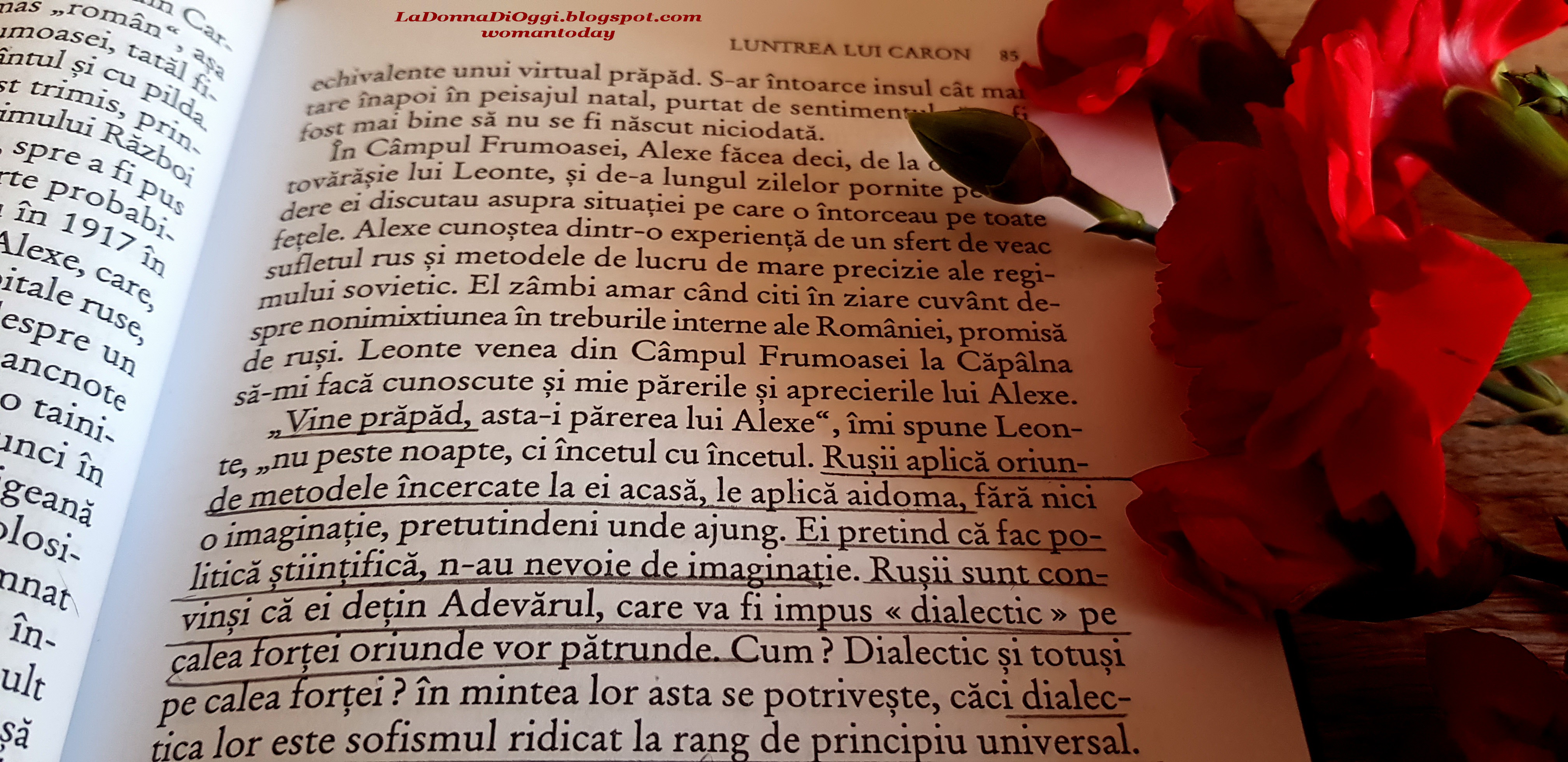
Luntrea lui Caron de Lucian Blaga - recenzie de carte / Il traghetto di Caronte di Lucian Blaga - recensione letteraria / Charon's Ferry by Lucian Blaga - book review


Dragi cititori,

Articolul de astazi trateaza unul din cele mai importante opere ale literaturii romanesti si anume romanul Luntrea lui Caron al poetului si filosofului Lucian Blaga. Cum probabil stiti, acest roman a facut parte timp de decenii din “literatura de sertar” a poporului nostru datorita limitarilor si interdictiilor arbitrare si nesabuite ale regimului comunist, fiind publicat postum, la 30 de ani de la moartea scriitorului.

In ciuda aspectului autobiografic, naratiunea este facuta la prima persoana, autorul se divide in doua personaje, poetul Axente Creanga si filosoful Leonte Patrascu pentru a surprinde in totalitate complexitatea vietii sale, Luntrea lui Caron este in esenta si un roman istoric intrucat zugraveste cu precizie uluitoare tumultul schimbarilor relative sfarsitului celui de-al doilea razboi mondial si instaurarii regimului comunist in Romania. Lucian Blaga surprinde metodic in toate componentele sale sosirea rusilor, promisii salvatori ai natiunii care prin manevre destabilizante creaza haos, teroare, nevoi pentru a propune in final un sistem materialistic, redundant si repetitiv in care constiinta este anulata si singurul organ de referinta ramanand stomacul. Multumita unor personaje diametral opuse, precum Alexe Pacurariu, intelectual burghez si erou in conflictele cu rusii, si Simion Barda, tanar scriitor de orientare marxista, fenomenul instaurarii este suprins in toata complexitatea retelelor create. In ciuda entuziasmului cu care Simion Barda asteapta aceste schimbari, nici “ochelarii de capastru” cu care regimul doteaza fiecare nou element al organismului, nu pot ascunde realitatea faptelor, o cursa a dezadaptatiilor social, a frustratilor si infometatiilor care va sfarsi contaminand intreaga natiune. In final, recunostiinta unui comunist se va manifesta doar prin punerea pe “linie moarta” spre diferenta de toti ceilalti cetateni “dotati” cu ceva agoniseli, experiente, functii care au sfarsit in inchisori sau "voluntari" la munca fortata. 

Intr-o perioada in care informatiile erau limitate, situatia era atat de disfunctionala incat stiri despre soarta svabilor din Romania, a fostilor functionari sau a cetatenilor care nu se adecvau tiparului, ieseau la iveala cu furia oarba pe care doar frica o poate alimenta. In aceste contexte Lucian Blaga introduce personaje pitoresti care dau culoare romanului si i-l anima, personaje precum Octavia si sotul ei, Popa Vasile, brodnicii ce asista  lumea in perindarea peste Mures, senzuala Ana Rares si adolescentinul ei sot, doamna Marga si satenii de la Capalna care croiesc universul acestui roman, contribuind la nararea aspectului politic si istoric sau fiind elemente cheie in povestile de dragoste si in poetica acestei lucrari. Dezvoltarea unui univers romantic in paralel cu evenimentele istorice si cu adevarate tratate de filozofie, stau ca marturie de neragaduit a talentului acestui scriitor roman. 

Lucian Blaga fusese numit pentru premiul Nobel de catre intelectualii epocii dar nebeneficiind de sustinerea guvernului sau intrucat personaj reactionar, i s-a negat aceasta recunoastere. Figura sa publica si creatiile precedente l-au salvat, asemeni altor oameni de seama, de la inchisori, tortura si moarte intrucat regimul nu dorea sa creeze martiri ci doar automate care raspund la comenzi.

Capacitatea lui Lucian Blaga de a crea figuri de stil este uimitoare, la fiecare pagina poeziile sale se contureaza in strofe sau pur si simplu astern drumul unor creatii, unor metafore revelatoare. In acest sens doresc sa mentionez metafora pastorului de lupi care isi ascunde si isi trece ciurda peste Mures nestingherit.

Luntrea lui Caron nu este doar o marturie, nu este doar un roman istoric ci este si un tratat de filozofie. In paginile sale gasim analize elaborate pe problematici politice, precum tratatul de la Ialta prin care occidentul a devenit unealta de expansiune a comunismului, religie, bogomilism, erezii, metamorfoza pacatului stramosesc patriotism, originea limbii romane si culminand cu analiza metamorfozei om – divinitate. Luntrea lui Caron este in acelasi timp punct de plecare pentru analize si reflectii elaborate precum si tratat bine structurat si elaborat de filosofie. Luntrea lui Caron e aproape un compendiu de cunoastere si din acest motiv lectura sa este un act indatorat.


ITALIANO

Carissimi lettori,

L'articolo di oggi riguarda una delle opere più importanti della letteratura rumena, ovvero il romanzo Il traghetto di Caronte, del poeta e filosofo Lucian Blaga. Come forse saprete, questo romanzo ha fatto parte per decenni della "letteratura da cassetto" del nostro popolo a causa delle limitazioni e dei divieti arbitrari e sconsiderati del regime comunista e viene quindi pubblicato postumo, 30 anni dopo la morte dello scrittore. 

Nonostante l'aspetto autobiografico, la narrazione è fatta in prima persona, l'autore è diviso in due personaggi, il poeta Axente Creanga e il filosofo Leonte Patrascu per cogliere appieno la complessità della sua vita, Il traghetto di Caronte è essenzialmente un romanzo storico in quanto dipinge con estrema chiarezza il tumulto dei cambiamenti relativi alla fine della seconda guerra mondiale e l'instaurazione del regime comunista in Romania. Lucian Blaga coglie metodicamente in tutte le sue componenti l'arrivo dei russi, promettenti salvatori della nazione che attraverso manovre destabilizzanti creano caos, terrore, per proporre finalmente un sistema materialistico, ridondante e ripetitivo in cui la coscienza è annullata e l'unico organo di riferimento rimasto è lo stomaco. Grazie a figure diametralmente opposte, come Alexe Pacurariu, intellettuale borghese ed eroe nei conflitti con i russi, e Simion Barda, giovane scrittore di orientamento marxista, il fenomeno dell'istaurazione viene sorpreso in tutta la complessità delle reti create. Nonostante l'entusiasmo con cui Simion Barda attende questi cambiamenti, nemmeno gli "occhiali da cavallo" di cui il regime equipaggia ogni nuovo elemento del suo organico, non possono nascondere la realtà dei fatti, una corsa di persone socialmente disadattate, frustrati e famelici che finirà per contaminare l'intera nazione. Alla fine, la gratitudine di un comunista si manifesterà solo mettendo su un "binario morto" a differenza di tutti gli altri cittadini "dotati" di alcuni risparmi, esperienze, posizioni, finiti in carceri o volontari ai lavori forzati. 

In un momento in cui le informazioni erano limitate, la situazione era così disfunzionale che le notizie sul destino degli svevi in ​​Romania, degli ex funzionari o dei cittadini che non si adattavano allo schema, sono venute alla luce con la rabbia cieca che solo la paura può alimentare. In questi contesti Lucian Blaga introduce personaggi pittoreschi che danno colore al romanzo e lo animano, personaggi come Octavia e suo marito, Prete Vasile, i barcaioli che assistono il mondo nel peregrinaggio su Mures, la sensuale Ana Rares e il marito dall’aspetto adolescente, la signora Marga ei paesani che plasmano l'universo di questo romanzo, contribuendo alla narrazione dell'aspetto politico e storico o essendo elementi chiave nelle storie d'amore e nella poetica di quest'opera. Lo sviluppo di un universo romantico in parallelo con gli eventi storici e con veri trattati di filosofia, rappresentano una preziosa testimonianza del talento di questo scrittore rumeno. Lucian Blaga all'epoca era stato nominato per il Premio Nobel dagli intellettuali europei, ma poiché non godeva del sostegno del suo governo in quanto figura reazionaria, gli fu negato questo riconoscimento. Alla fine, essere un personaggio pubblico e le precedenti creazioni lo salvarono, come successe ad altre persone importanti, dalle carceri, dalle torture e dalla morte perché il regime non voleva creare martiri ma solo automi che rispondono agli ordini.

La capacità di Lucian Blaga di creare figure stilistiche è sorprendente, in ogni pagina le sue poesie sono tratteggiate in strofe o semplicemente tracciano il percorso di altre creazioni, di alcune metafore rivelatrici. In questo senso vorrei citare la metafora del pastore di lupi che nasconde e passa il suo gregge su Mures senza ostacoli.

Il traghetto di Caronte non è solo una testimonianza, non è solo un romanzo storico ma anche un trattato di filosofia. Nelle sue pagine troviamo analisi elaborate su questioni politiche, come il Trattato di Yalta con il quale l'Occidente divenne strumento per l'espansione del comunismo, religione, bogomilismo, eresie, metamorfosi del peccato ancestrale, patriottismo, origine della lingua romena e culminando nell'analisi della metamorfosi uomo-divinità. La barca di Caron è allo stesso tempo un punto di partenza per elaborate analisi e riflessioni, nonché un ben strutturato ed elaborato trattato di filosofia. Il romanzo “Il traghetto di Caronte” è quasi un compendio di conoscenze e per questo motivo, leggerlo è un dovere.


ENGLISH

Dear readers,

Today's article is about one of the most important works of Romanian literature, namely the novel Charon's Ferry by the poet and philosopher Lucian Blaga. As you may know, this novel has been part of the "drawer literature" of our people for decades due to the arbitrary and thoughtless limitations and prohibitions of the communist regime and is therefore published posthumously, 30 years after the writer's death. 

Despite the autobiographical aspect, the narration is done in the first person, the author is divided into two characters, the poet Axente Creanga and the philosopher Leonte Patrascu, to fully grasp the complexity of his life, Charon's Ferry is essentially a historical novel as it paints with extreme clarity the tumult of the changes related to the end of the Second World War and the establishment of the communist regime in Romania. Lucian Blaga methodically captures in all its components the arrival of the Russians, promising saviors of the nation who through destabilizing maneuvers create chaos, terror, to finally propose a materialistic, redundant and repetitive system in which conscience is nullified and the only organ of reference left, is the stomach. Thanks to diametrically opposed figures, such as Alexe Pacurariu, bourgeois intellectual and hero in the conflicts with the Russians, and Simion Barda, a young writer of Marxist orientation, the phenomenon of the establishment is surprised in all the complexity of the networks created. Despite the enthusiasm with which Simion Barda awaits these changes, not even the "horse glasses" with which the regime equips each new element of its staff can hide the reality of the facts, a race of socially maladjusted, frustrated and hungry people that will end up contaminating the entire nation. In the end, the gratitude of a communist will only manifest itself by putting on a "dead-end track", unlike all the other citizens "gifted" with some savings, experience, positions, that end up in prison or “volunteering” for forced labor. 

At a time when information was limited, the situation was so dysfunctional that news about the fate of the Swabians in Romania, of former officials or citizens who did not fit the pattern, came to light with the blind rage that only fear can fuel. In these contexts Lucian Blaga introduces picturesque characters who give color to the novel and animate it, characters like Octavia and her husband, Priest Vasile, the boatmen who assist the world in the pilgrimage on Mures, the sensual Ana Rares and her adolescent-looking husband, Mrs. Marga and the villagers who shape the universe of this novel, contributing to the narration of the political and historical aspect, or being key elements in the love stories and poetics of this novel. The development of a romantic universe in parallel with historical events and with real philosophical treatises, represent a precious testimony of the talent of this Romanian writer. Lucian Blaga had been nominated for the Nobel Prize by European intellectuals at the time, but since he did not enjoy the support of his government as a reactionary figure, he was denied this recognition. In the end, his previous creations and being a public figure, saved him, as happened to other important people, from prisons, torture and death because the regime did not want to create martyrs but only automatons that respond to orders.

Lucian Blaga's ability to create stylistic figures is surprising, on each page his poems are outlined in stanzas or simply trace the path of other creations, of some revealing metaphors. In this sense I would like to mention the metaphor of the wolf shepherd who hides and passes his flock on Mures without obstacles.

Charon's Ferry is not only a testimony, it is not only a historical novel but also a philosophical treatise. In its pages we find elaborate analyses on political issues, such as the Yalta Treaty with which the West became an instrument for the expansion of communism, religion, Bogomilism, heresies, metamorphosis of ancestral sin, patriotism, origin of the Romanian language and culminating in the analysis of the metamorphosis man-divinity. Charon's Ferry is at the same time a starting point for elaborate analyses and reflections, as well as a well-structured and elaborate treatise on philosophy. The novel "Caron's Boat" is almost a compendium of knowledge and for this reason, reading it is a must.


Pentru a realiza aceasta recenzie am citit in limba romana, romanul Luntrea lui Caron, de Lucian Blaga, 583 pagine, editura Humanitas, 2019, ISBN 978-973-50-6558-4

Per scrivere questa recensione ho letto in rumeno il romanzo Il traghetto di Caronte, di Lucian Blaga, 583 pagine, casa editrice Humanitas, 2019, ISBN 978-973-50-6558-4

To write this review, I read in Romanian, the novel Charon's Ferry, by Lucian Blaga, 583 pages, Humanitas publishing house, 2019, ISBN 978-973-50-6558-4


Disclaimer e premesse / Disclaimer and premises

IT: Questo post non ha scopi commerciali e non incoraggia vendite, denominazioni, immagini ed eventuali link presenti sono solo a scopo informativo. Le immagini ritraggono un prodotto acquistato regolarmente che ho valutato in quanto consumatore. Questo post è di mia completa creazione per quanto riguarda contenuti, foto e idee espresse. Prima di usare qualsiasi parte di questo post siete pregati di contattarmi e nel caso vi abbia ispirato per altre creazioni, vi chiedo cortesemente di menzionare la fonte.

ENG: This post has no commercial purposes and does not encourage sales, names, pictures and eventual links are present only for an informative purpose. The images depict a regularly purchased product that I have evaluated as a consumer. This post is of my entire creation as for contents, photos and expressed ideas. Before using any part of it, you need to contact me and in case it inspired you for other creations, I gently ask you to mention the source.

Recommended post

Solo Cose Belle ottobre 2024 parte 1 / Only Beautiful Things October 2024 part 1

ITALIANO   Ciao carissimi amici,  Finalmente riesco a scrivere il post in merito alle cose belle che ho vissuto durante il mese corrente e s...